Showing posts with label Classics. Show all posts

Saturday, September 18, 2021

Tumult Unceasing!

now finished: The Iliad by Homer 

 I have finally read The Iliad.

Wait, no. I have finally! read The Iliad! 

The epic thing, pages and pages and pages of hexameter, Books 1-24. Of which, I might add, I deem at least two unnecessary. We could easily do without the early on one that reads like the Old Testament, droning on and on about so-and-so and so-and-so and the son of so-and-so, just name after name after name. No one cares*, Homer. (Same to you, OT prophet scribes.)  And, that Book 23, fever dream, opponent-dragging, don't-call-it-a-climax, don't-call-it-a-denouement chariot race is just....what? Who took over the directing of this episode? Tarantino? That Enter the Void guy**? 

Anyway. 


I liked reading The Iliad! Did I mention it's epic? So violent by the way, much like a Game of Thrones episode. The various bone-splitting, tendon-slicing, helmet-crushing, brain-spurting injuries and kills are gruesome and vividly rendered. 

Here's what I didn't know: that there was so much Olympian gods chicanery involved in this. I really had spent four decades (or, three, I suppose) thinking it was more realistic than magical realism. Like, wheeeeeeee! gods just routinely step into our lives and do stuff. The whole (epic!) thing is honestly so similar to the impending biblical Christianity  sensibility of war-fate-storytelling that I don't understand how anybody believes in any one monotheism god as opposed to all-those-pagan-gods. It's all part and parcel.  Humans are so weird. 

On that note, one time Zeus points out how terrible humans are. Zeus. Zeus! The jerkiest of jerks! He has this to say: 

"For there is nothing more wretched than mankind / of all things that breathe and creep upon the earth. "              -- Book 17 

You are not kidding, son of Cronus. 

Besides Achilles hanging around his ships lamenting how things are, and everybody but everybody considering women "prizes" to be won, taken, and stolen, the other main thing that happens throughout The Iliad are these wandering metaphors. "Then the Trojan warriors came," he'll say, "like a pack of wolves, who trot up the mountain, you know the kind I mean, with snouts toward the moon, like a lost wandering beast who knows its meal waits just around the bend, the kind of meal he can sink his teeth into, a wolf's tooth, the kind you wear around your neck; up the mountain they went  like these wolves, as a clan of mystic seekers whose blood scent leads them on, like a man who has lost his only friend..."***   It goes on like that for a while, and then eventually the sentence ends and we can find out what the Trojans did. 

Why did I read The Iliad now?  (Besides the obvious why not, of course.) Well, lately I have been realizing that everyone seems to remember a whole lot more of the Greek mythology we read in junior high than I do. See, e.g., any given episode of Jeopardy! I was like WHY DO YOU ALL KNOW ALL THIS STUFF. Granted that it is definitely not because y'all have sat down and read The Iliad, I know that, but I am the Literary One, so I have to do the reading. I decided to invent an Ancient Greek Things class for myself and I have added some mythology and gods and classic epics books to my nearest stacks and I am filling in some knowledge gaps. 

Also it's college football season, which is a great time to get hyped when "A dark cloud of Trojans now closes round..."  (Book 16)

The Iliad! 

p.s. Agamemnon reminds me a bit of tr$mptydumpty. 


*yes I am aware it is of historical interest and some people care

**his name is Gaspar Noé. ugh. 

***I made that up, but barely


Sunday, January 11, 2015

Not THAT A to Z ...
A Blog Book Survey

Stolen from another blog, I give you my answers to the A to Z Book Survey! I'm pretty sure all the Kidz 2-day doing the survey include images for each letter...you'll be lucky to get a handful of pictures from me! I always say, a thousand words are worth a picture...

A - Author You've Read the Most

Oh gosh, I'm not sure! Look at me already failing on the first question. But I mean, should this be the most individual books? Because that would be Dr. Seuss, I think. Number of pages? That might be Tolstoy, after only a couple of books. If we're not counting Seuss and Tolstoy, then it's gonna be either Sandra Scoppettone, Nelson DeMille, or Virginia Woolf - I've read about a dozen books from each of those three. If I weren't lazy about images (see above), I'd post a lesbian/mystery Venn Diagram to illustrate this answer.

Men Against the Sea (The Bounty Trilogy, #2)B - Best Sequel
Ooooh, good question. Oh, man, The Two Towers doesn't really count as a sequel, right, book-wise, because The Lord of the Rings is actually all one book, even though it's not. Hmmm. Well, if not that, then let's go with Men Against the Sea, the second book in the (Mutiny on the) Bounty trilogy. I adored Men Against the Sea.  I felt so impressed by and fond of the men and their boat that saved them. What a great yarn. Worth a look!

C - Currently Reading
I'm in the middle of the very good Truman by David McCullough, the current selection in my prez bios reading project, but also fiction-wise quickly blazing through Inherent Vice on the side (my second Thomas Pynchon) so then I can go see the movie.

D - Drink of Choice While Reading
So, coffee. Obviously.

E - E-reader or Physical Books?
I do not enjoy e-reading books. I have done a few, and found it convenient to be able to purchase and borrow books that way, especially when living abroad, but I do not really enjoy it. Here's to page-turning!

F - Fictional Character You Probably Would Have Dated in High School
Um. I had no idea who I was or who the people I wanted to date were in high school. With that caveat, and knowing that it would probably not have been a good idea, I probably would have dated someone truly messed up like Laurent in Therese Raquin, or at least someone very confused, like Rob in High Fidelity -- confused but who likes music. Definitely, there would have been music involved.

G - Glad You Gave This Book a Chance
Let's go with The Sisterhood of the Traveling Pants. Before it became cool for adults everywhere to shamelessly read Young Adult because staring at screens has altered their brains and attention spans so much that they can't read lengthy amounts of words on pages anymore, I worked at Borders and there was an intriguing little green paperback bestseller that I became inspired to pick up and Oh.My.Goodness do I just love the hell out of that book. Read the sequels, saw the movie, and did a bit of spreading the gospel, but just in general, if you think The Sisterhood of the Traveling Pants is for some reason not worth your time, think again!

H - Hidden Gem Book 
This has got to be either Night and Day by Virginia Woolf , which seems to get exactly no attention, even from academic/feminist/Anglophile/literary devotees but which I maintain is one of Woolf's best, or Tepper Isn't Going Out  by Calvin Trillin, which gets no attention from anyone except me and Brian.


I - Important Moment in Your Reading Life
The obvious answer would probably be something about War and Peace, no?  But I think it might actually be when the Modern Library published their list of the Top 100 books (two lists, actually, one for novels and one for non-fiction) and I printed them out and highlighted and set out on a quest, and have since continued finding quests and projects and lists of books to read and I absolutely love doing this!! (Making lists of books to read next is a hobby of mine.)

J - Just Finished
Um, speaking of lists, Smoky the Cowhorse. Among other checklists I'm working my way through: the Newbery Medal Winners. Good ol' Smoky hails from the early days of that award, the 1920s.

K - Kinds of Books You Won't Read
Twilight.

 L - Longest Book You've Ever ReadOh my goodness, so many candidates. Now I have to go check which is longest out of  Anna Karenina, War and Peace, Infinite Jest, or Dream of Red Mansions/Chamber aka The Story of the Stone....ahhh, forget it, you can go look up how many pages yourself. I like long books. Proust, I'm coming for you.

M - Major Book Hangover Because Of...P
robably Into Thin Air. I couldn't shake that for months. And all I did was talk about it, with other people under the influence from it.

N - Number of Bookcases You Own 
There are three here in this living room, with Brian's and my books. Before my Great Book Sell-Off of 2006, I had about five tall ones and then some filled in Boston...there are books in houses in Phoenix...I don't really know/care how to answer this question other than literally. I guess I co-own three.

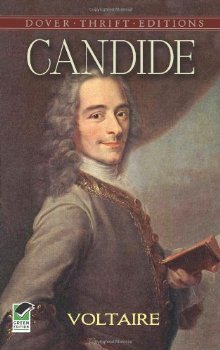
O - One Book You Have Read Multiple Times Again, besides Dr. Seuss? That would be Candide. Voltaire forever!


P - Preferred Place to Read 
Anywhere quiet.
A steady hum of sounds is OK. Jabbering, cell phone conversations, sitcoms, etc.? Not.

Q - Quote That Inspires You or Gives You All of the Feels From a Book You Have ReadObviously, Candide: "That is very well said, but we must cultivate our garden."

R - Reading RegretOther than maybe Cynthia Ozick, nothing I've actually read, but more all the time I've wasted not reading in this life.

S - Series You Started But Need to FinishSome people would say Harry Potter (I've read the first half of the first book...twice...)  Definitely not Sue Grafton's Kinsey Millhone ABCs, as I am So done with  all that. Let's see, what could it be? I haven't started Game of Thrones, really, though I did read the first few pages of the first, and that's my next-up series, I believe...I can't really think of any. Wait, Alafair Burke's Samantha Kincaid and Ellie Hatcher books are series, right? But she's still writing, and this is supposed to be a complete series. Ugh. Can I use Proust here, too?  Well, wait, actually, I think Alafair Burke is done writing Samantha Kincaid, she said, now that she's in New York. And I've read two of the Portland-set Kincaid series and need to read the third. So, that.

T - Three of Your All-Time Favorite Books(You see where I've already mentioned Candide and War and Peace multiple times, right?)
How about:
Lonesome Dove by Larry McMurtry
Pilgrim at Tinker Creek by Annie Dillard
Man's Search for Meaning by Viktor Frankl

U - Unapologetic Fangirl For...
Um.
Fangirl? Me? Ummm...
Anna Quindlen?

V - Very Excited for This Release More Than Any Other
 
Would it just be wrong to say my own book?
I'm so not the release-anticipating type with books. I've fallen behind on all my still-writing living authors (Atwood, Berg, DeMille, et. al.) I've got one word for you, kid: classics.

W - Worst Book Habit
Sitting here with a laptop on my lap instead of picking up a book?
Judging people who read trash?  (I mean real trash, like Twilight; I'm not disparaging the genres here.)
Disparaging genre fiction?
Forgetting what I've read?

You tell me; which is the worst?

X - X Marks the Spot: Pick the 27th Book on Your Bookshelf (from the upper left)
Dashiell Hammett, The Maltese Falcon

Y - Your Latest Book Purchase
Pretty sure it was at Schuler over Christmas when I picked up Night Train by Martin Amis and Game of Thrones by the inimitable conscientious objector George R.R. Martin. Have I bought anything since then? I don't think so. I tried to get Vanity Fair at our neighborhood bookstore in Lincoln Square, The Book Cellar, but couldn't find it, and at Women & Children First, I tried to get our next book group book, Eichmann in Jerusalem,  and they were sold out of that! So, back to the library...

Z - ZZZ Snatcher: Book That Kept You Up Way Too LateThis has not happened in SO long. I am a champion of falling asleep these days. I love getting sleep. I can't remember staying up reading, sucked in, since I was in Andong (Korea, in 2011)...either Freedom by Jonathan Franzen or Long Gone by Alafair Burke; I remember being up late reading both of those that year.

What a fun survey!

How about you?


Thursday, January 08, 2015

Check-in time
A look at what 15-year-old me declared she would read...

In case anyone thought this whole making-lists-of-books-I-want-to-read habit was a new thing or started in adulthood or (god forbid) a Goodreads-inspired internet solution (in that last case, you should probably go read To Save Everything, Click Here and stop thinking about the internet as the only and ultimate solution for everything), we have actual evidence to the contrary. I have here an old notebook from my junior year of high school in which I wrote some goals for the New Year, including the aspiration to "read 100 books (as in, good ones)."  I'm terribly curious as to what kind of unworthy books I thought I would  be tempted to read that needed to be excluded from the list...young adult, maybe? *smirk*.. but in any case I then gave some examples
of what I should read. Here's the list, from my 15-year-old self to you:

  • The Scriptures
  • Les Miserables
  • Jesus the Christ
  • A Marvelous Work and a Wonder
  • To Kill a Mockingbird
  • [The] Catcher in the Rye
  • Uncle Tom's Cabin
  • Wuthering Heights
  • War and Peace 
  • etc.
Gotta love the "etc."  Couldn't be bothered to actually list 100? Or is it because I reached the end of the page? The top of the next page of the notebook begins with a new topic, "WAR." Oh, yes, I was me. Gotta also entirely love that War and Peace made the list. I feel satisfied knowing that even at such a tender age, I was fully aware of my destiny. Great stuff, teenage Linda. (Who was at that time, as evidenced by some of the more Christ-y entries on the list, most assuredly still a Linda With Borders, eh?) 

So, then?? Status report? Well, here we are two decades later and I have completed more than half of that list, but not quite all. I did apparently start at the beginning, because I remember that school year I indeed delved into scripture (and yes, I did read The Whole Thing, though it took a few years) and Les Miserables. I am terribly sad to report I read only about 250 pages of that long novel (obviously, unabridged; what do you take me for?!) that year. Well, guess what, it is totes on the 2015 list anyway, for me and Brian. How about that! What else? I read The Catcher in the Rye later, during the summer after my senior year, then finally got around to  Wuthering Heights and To Kill a Mockingbird a few years after that, in adult life. In Boston, I read a good chunk of Uncle Tom's Cabin, maybe 100 pages or so, but didn't finish, and of course we all know that in 2005 I had the good sense to tackle War and Peace. I wonder if I ever read much of Jesus the Christ and A Marvelous Work and a Wonder...hmmm. I know I've touched those (and they're still on my mom's bookshelves to this day) but nothing sticks with me, and I can't say I have any interest in reading them now. The Mormon General Authorities and higher-ups are kind of like tenured professors, I think, in their writing. They might be technically competent and even have interesting things to say, but they're not really inspired to write a book so much as they are compelled by their life situation to write about their topics of expertise. And we all know how I feel about reading academic journal articles that are more concerned with citation than narrative.

Now, about that "etc."...

Thursday, January 01, 2015

The Best and Worst I Read in 2014

I read 72 books in 2014! Well, OK, I read sixty-something books and I listened to a handful as audio books on my mp3 player while out walking or running. But for the purposes of this blog entry, same thing. Let's take a look at my 2014 year of reading in review!

I read more truly great non-fiction than truly great fiction this year. While I enjoy reading non-fiction and obviously love when it's great, I would also really like to be able to read more great novels, too, and by that I mean, I would like to stop being so disappointed in more than half of the novels I pick up. But we'll get to that in a second. First...

THE GOOD:
Easily the two best novels I read this year were Almanac of the Dead by Leslie Marmon Silko and Time's Arrow by Martin Amis. Both deal with the utter horror show that is humanity but in completely and totally different ways. The former is a gargantuan tome of Native American-Mexican-Arizonan-bring-on-the-revolution wisdom that will shock, horrify, and awe you if you have any ethical bones in your body. It will also teach you some history, make you homesick for Arizona if you're from there, cause you to seriously ponder your role in society and humans' role on the American continent and the globe, and possibly inspire a little tiny eensy bit of hope for the world. (But not too much.) There's also a fair amount of sex and drugs mixed in. It's hard to explain. The latter is Amis' famous novel told in reverse about a Holocaust "doctor" -- in order to grapple with the how-could-this-happen and how-did-he/they/we-become-evil questions, he tells the story backwards and it's basically genius.  I cannot recommend these two books highly enough.

The other good novel I read this year was Men Against the Sea by Charles Bernard Nordhoff, the second in the Bounty Trilogy. Actually, the first, Mutiny on the Bounty, was all right, too, but the struggle of the men in the boat in the second book is just so hardcore, and you end with so much respect for them and an understanding of their deep love for the boat that helped them and brought them to safety.

The great non-fiction I read this year includes:
Bury My Heart at Wounded Knee by Dee Brown -- This history of what happened to Indians in the American West should be required reading for everyone. The Shadow of Blooming Grove: Warren G. Harding in His Times by Francis Russell -- Yes, you actually do need to read a biography of Warren G. Harding, if for nothing else than for the shenanigans of the smoke-filled rooms at the 1920 Republican convention and for his kindness to puppies.
The Walrus and the Elephants: John Lennon's Years of Revolution by James A Mitchell -- I was born too late (to live in the early '70s) but John Lennon wasn't and he was incredible and I previously had no idea how hard the U.S. government tried to get rid of them. (And succeeded?)To Save Everything, Click Here: The Folly of Technological Solutionism by Evgeny Morozov --  If you hate when people say "X changed my life" or when people are hailed as brilliant because they gave a TED Talk even though they are physically incapable of critical thinking, you'll dig Evgeny's thesis. If you are bristling at these notions, you are in need of Evgeny's thesis.Zola and His Time: The History of his Martial Career in Letters by Matthew Josephson -- When I finally got around to reading a Zola book (Therese Raquin) the other year, I was less than impressed. But! This bio re-fascinated me about him. And poor, poor Dreyfus (he of the Affair) -- such a fascinating bit of history and a groovy group of literary pals, who are definitely not without their flaws. 
THE BAD: 
Get out of my face, Gone Girl, The Interestings, Sue Grafton, Sharon Olds (Stag's Leap and her undeserved Pulitzer in particular) and, frankly, Sophie's Choice, too. So much disappointment!
THE UNDERWHELMING: 
The Fault in Our Stars, The Amazing Adventures of Kavalier and Clay, Little Women (re-visited as an adult), No Ordinary Time, and some of Truman Capote's short stories included in the volume along with Breakfast at Tiffany's.  SOME FUN SURPRISES: The Wicked Pavilion  by Dawn Powell. Who knew?
The Moonstone by Wilkie Collins. Check it out if you want a classic novel that's also basically a pioneering mystery novel and not on everyone's radar.
Missing Justice by Alafair Burke. Even though I've read a few of her novels previously and I am well acquainted with her and her life commentary, I was still delighted by the sharp feminism in this page-turner.
Also, 10 A ños con Mafalda, a collection of the Argentine comic strip Mafalda, opened my eyes to a bit of social history I never would have otherwise known. 
And you? How was your 2014 reading?

Tuesday, July 15, 2014

July 15th: Anton Chekhov
A Month of Short Stories and Their Authors

now reading: Martin Amis: The Biography by Richard Bradford

I must say that my first experience with Chekhov didn't go so well. But I was fifteen years old at the time. What did I know? I've since fallen in love with all things Russian literature. Isn't it high time I revisit ol' Chekhov?

Today's Story: "The Looking Glass"
Author: Anton Chekhov
My Rating: A

This is a short but sweet (or well, you know, bittersweet...emotional...a little worrisome...depressing...take your pick) story about a girl ("young and pretty") who is gazing into her looking-glass while dreaming about getting married. Let's talk about the term "looking glass" for a second. This is one of those things that is absolutely positively one hundred percent not used in USA English (I have no idea about Canada, I realize...Canadians?) but that we are easily able to understand is a mirror. Once we learn it, that is. When we are eight or nine years old and have finished reading Alice in Wonderland and pick up the sequel Through the Looking Glass, we might not know that a looking glass is a mirror and we might at first be unsure of what exactly is happening to Alice and what sort of glass she is falling through, thinking maybe it's a window or something, until we are finally bonked over the head with a sort of "Duh!"  Because, simply put, it's a mirror. So this just gets me feathers all ruffled thinking about how stupid it is to "Americanize" (and or "USA-ize, pending what we hear from Canadians) English-English books. FOR EXAMPLE: Harry Potter and the Philosopher's/Sorcerer's Stone. Ugh. I like the idea of learning about one another's English usage, with footnotes if necessary, not translating English-English to USA-English, when I read. Who's with me? I know that it can lead to confusion sometimes when you don't have footnotes, but that's OK. It's a learning experience! Anyway, whoever translated the Chekhov obviously used the term "looking glass" and not mirror. And so here we are.

True or False: Chekhov writes a lot about women. I'm totally cool with that, Anton, but I really need to read more of your stuff. It was Three Sisters that did me in, at age fifteen, at theater camp. Had to perform an abridged version of it. Was miserable. Can't even remember the name of the acting coach who directed us in that scene, but I remember actually hiding out in the bathroom one day trying to figure out a way to not return to his classroom and not have to rehearse the scene. With hindsight, I think that whether or not he was a great acting coach of teenagers (especially sheltered and immature ones), I was clearly the pathetic one. I do believe it was Lori and Penny and I playing the three sisters--and I'm not even sure which one I was. I'm thinking maybe Irina. Really, the plot is lost to my memory, everything is lost to my memory except the utter misery I felt the entire several weeks of rehearsing. What's funny about that is that I had to burst into tears in the scene, acting-wise, and you'd think I should have been easily able to do that, what with being miserable and all. Why was I so miserable? I don't know! It was just miserable! Which is just so weird seeing as I have grown very fond of angst, drama, and Russian lit over the years. Did I just not know myself yet? (This is a distinct possibility.) How did the performance go? Well, all three of us were nominated for acting awards, and the director of the entire workshop did initiate a standing ovation for us. (But really, not for me. Probably mostly for Penny; she was actually a good actress.) I think it's just because he adored Chekhov, and Three Sisters was famously his favorite play, which, you know, no pressure! That's probably why our director was so hard on us and why I was so miserable. I swore off Chekhov after that summer.

And now here I am, in a cold and gray and windy Michigan summer (yes, this is what passes for July around here; might as well be in exile in Siberia or something) reading a little more Chekhov. "The Looking-Glass" has a plot that is entirely imagined but that is vividly rendered. It makes sense when you read it. It leaves you with lots of profound questions like "What does it mean to join my life with that of another?"  and "What do we owe our neighbors?" (not to mention our horses) and "Is life at all worth living, since it will inevitably be filled with sad and terrible events?"  That Chekhov, fun guy. Let's all have a beer, no?! Seriously. !@#&*Russians. Love them.

And so, I hereby heartily recommend this great story and I hereby also pledge to reread Chekhov's Three Sisters and try to figure out just exactly what was wrong with my unable-to-appreciate-it-fifteen-year-old-self (perhaps Taylor Swift can weigh in?), and I also apologize to the universe for allowing my personal adolescent misery to prevent me from fully appreciating the beautifully rendered misery of others.


Wednesday, July 09, 2014

July 9th: James Joyce
A Month of Short Stories and Their Authors

now finished re-reading: "The Metamorphosis"/"Die Verwandlung" by Franz Kafka
now reading: Sophie's Choice by William Styron


Kafka, Styron, and Joyce...someone might call these guys "writer's writers," if that weren't such a weird way to talk about creative people. (Not that it stops the critics. "She's a real songwriter's songwriter," you sometimes hear. We understand what it means, but it still seems like a phrase to use when you can think of no other words to describe the artist -- truly no other words, so you just use "artist" again.)

Today's Story: "Clay"
Author: James Joyce
My Rating: B

Reading this story, "Clay," puts me in mind of the eternal question I ask myself as a writer (well, one of them): do I want any and all readers to understand my work? Do I care if they don't get it? Does it matter if I refer to things that are clear and obvious now, or known to many people, but that in the future will be confusing, or baffle some folk?

In short, do I want to be one of those annoying pieces in the Norton Anthology where the footnotes take up more of the pages than the actual text? No, I do not. But will I be?  ???  Over time, the things which we find so familiar will be altered beyond recognition. And even now, I know some people have a hard time keeping up with my allusions, although I don't say that in a literary snobby way, just an "I-talk-a-lot-and-throw-in-a-lot-of-random-Clue-and-Designing-Women-references" way.

Then again, even a one-footnote story puts forth this eternal question, because were it not for the footnote in this particular case, and despite the story's title, I wouldn't have known that Maria had stuck her hand into the clay, nor known that choosing the clay is ominous. Is this an Irish thing? A 1915 thing? I have no idea. Never heard of it. Never heard of the Hallowe'en game they're playing, in fact. So maybe I'm just unimpressed because I'm confused, but James gets a deduction and the grade is a B. Not fair? (Who ever said I was a fair grader? It's my freakin' blog, after all.) Well, I hardly think that anyone coming to the defense of James Joyce's writing is going to try, "You're just ignorant; he doesn't make any obscure allusions" for the thrust of their argument.

Oh, James Joyce. Good writer, that boy. Are his short stories deceptively simple? Are his deft turns of phrase like Forster's, with more than meets the elegance-beholding eye? Is he as wise as Tolstoy about the human condition? (OK, no on that one, sorry.) Is he the Dante of his generation? The Da Vinci? The Bono?

In AP English my senior year of high school, we were all set to read A Portrait of the Artist as a Young Man. We knew this was coming, because as I previously mentioned in my Kafka entry, my sister and several of my classmates' older siblings were two years ahead of us and the English department pretty much kept the biggies of the curriculum the same, at least not altering them in just a couple of years. Now, it wasn't to be our first time around the James Joyce block cul-de-sac, as we had studied "Araby" the year before, but anyway, the novel loomed. And then our teacher, who had taken over AP English that year from our sisters' teacher who departed in the wake of a messy life/divorce incident, discovered that we had not yet read Adventures of Huckleberry Finn. She was incredulous. At first she thought one student was saying he alone hadn't read it, like, he had blown it off sophomore year or whatever. No, we explained, to this teacher who had in previous years taught the "average" and remedial English classes and wasn't familiar with us, the accelerated/Advanced Placement crowd who'd gone through our four years of high school together, we didn't read that in sophomore year American Lit. None of us read it. We read The Scarlet Letter  and Moby Dick that year and assorted other things, but no Huckleberry Finn. She immediately scrapped Portrait of the Artist as a Young Man and hauled out her set of Huckleberry Finn  classroom copies, which we AP seniors surely eyed with disdain, as they were normally handled by, you know, sophomores. And not even advanced  sophomores. Do I now look back on her decision approvingly? Do I agree with her that any self-respecting English student must study Huckleberry Finn in American Lit?  Yeah, sure. But we hated the very idea of being senior AP English students reading the same book as the average sophomores. What a delicious whirlwind of meta-pretentious thought, no? Joyce should be proud.

Before you can become an artist, you must rid yourself of all the baggage of your "influences." But what games did you play on All Hallows' Eve, James Joyce, that now haunt Maria and me? What twists of fate await us, blindfolded, when we try to reach for our destiny? And when the hell will I ever get around to reading Ulysses?

Monday, July 07, 2014

A Month of Short Stories and Their Authors
July 7th: Virginia Woolf

now finished: F Is for Fugitive by Sue Grafton
now reading: Best Short Stories/Die schönsten Erzählungen by Franz Kafka
and Men Against the Sea by Charles Bernard Nordhoff and James Norman Hall
up next:  a few mystery thrillers and more William Styron

So, today I may be kind of cheating, or at least approaching my July blog project a little differently, because today's story isn't really a short story -- or is it? One is never too sure of these things.

Today's Story: "The Mark on the Wall"
Author: Virginia Woolf
My Rating: A-

It may also be cheating, or simply impossible, to try to explain all of my experience with/feelings about/analysis of Virginia Woolf in one blog entry, so we shan't expect that to happen. But first things first: is "The Mark on the Wall" a short story, and if not, what then should we call a sketch like this by our gal Virginia, or by any other consciousness-streaming author?

I think "The Mark on the Wall" succeeds because it wraps humor, longing, and awareness into one big package of thoughts that carry the reader along on the stream of consciousness. There is no plot and there are hardly any characters, but it's more than just a rumination on life, because the voice is very much a narrator who is doing something, even if that something is mostly thinking. This story makes me think that Virginia Woolf would have been a great blogger. Would she have liked to blog? She might have brought some fretting to the process -- one can imagine, for example, her responding to trolls and getting caught up in some nonsense comment war -- but just in general it seems like something she would have been great at if she had done it. She always found these moments worth musing about, and although she's widely considered to have been temperamentally unfit for all of the poised schmoozing of happy little social butterflies, she still knew people, related stories, and wanted to connect. Bingo! That's pretty much 80% of bloggers, no?

And "The Mark on the Wall" is not just  a flow of thoughts about what the mark on the wall might be, but also a wink-wink reflection on those thoughts:

I want to think quietly, calmly, spaciously, never to be interrupted, never to have to rise from my chair, to slip easily from one thing to another, without any sense of hostility, or obstacle.I want to sink deeper and deeper, away from the surface, with its hard separate facts. To steady myself, let me catch hold of the first idea that passes. . . Shakespeare. . . . Well, he will do as well as another. A man who sat himself solidly in an armchair, and looked into the fire, so--"  (The Norton Anthology of English Literature, Third Edition, 1974, p. 2310)

The layers of writer brain and creation in each paragraph of this story (sketch) are remarkable. With commentary on the past, the future, a ton of the present, and the process of the mind figuring things out, it's like a meta-creation, detailing the process of observing something on Earth and reproducing it as art. But it's also a person sitting looking at the mark on the wall above the fireplace -- and too lazy to get up and see what it actually is.

No spoilers here! You'll have to read the story yourself to find out.

Obviously, I do like Virginia Woolf. A lot of people aren't at all prepared for her when they first read her, so they just have no idea what's going on (which is, simply put, a lot) and for those people I guess I recommend starting with Night and Day -- although you'll have to go back and read it again later anyway once you totally get her more. I read Jacob's Room early on in my Woolf-life, and it became one of my top ten novels. I have also read a bunch of other stuff: To the Lighthouse  and Mrs. Dalloway, obviously, and Orlando, and The Voyage Out, Kew Gardens, A Room of One's Own, The Waves (which by the way is phenomenal) plus some of The Common Reader and Three Guineas...and maybe one or two others. I thought I had read Monday or Tuesday but if I did, I didn't remember much about "The Mark on the Wall," which appeared in it -- but as I said (and many others have said), whatever Woolf you read when you were twenty years old, you really need to re-read now anyway.


Thursday, April 10, 2014

Potpourri of February/March Reads

Some recent reads, in rough order of worthiness from best to worst:

These were good and/or great
The Moonstone by Wilkie Collins
August: Osage County by Tracy Letts
Lonely Planet's Phuket Encounter

These were meh/suspect
The Crazed by Ha Jin
Coolidge by Amity Shlaes


This one should be thrown across the room
Gone Girl by Gillian Flynn

Yes, that's correct. Gone Girl is in dead last on the list. I'll get to that in a second. Oh wait, maybe I should say "I'll get to that in literally one second." Which is not true, because it's going to be more than one second, and the expression "I'll get to that in a second" is FIGURATIVE, but apparently the authors and editors in the publishing industry today (see also: The Hunger Games) don't actually have to know what "literally" means but they can use it over and over and over (literally dozens of times!) in these contemporary please-take-me-seriously novels, jarring the reader (but not literally jarring, because how could an author put me in a jar?) and making it so obvious it's the author's voice coming through. Not the literary voice or the writing voice, but the text message voice. That doesn't really work when you tell a story from the points of view of two different characters, but they both just sound like you replying to an email.

Contrast that with The Moonstone, a gem (see what I did there?) from Victorian England, but not your English teacher's Victorian England novel. It has been called "the first detective novel" (would Agatha Christie and the author of The Invention of Murder agree?) but what's so great about it is the narration. There are a few point of view shifts, and each character's distinct attributes are fun, but the snark of the old servant who tells the first half is an unbeatable delight. I love reading classics for numerous reasons, but the fact that they are better edited than most of the crap on front-of-bookstore tables is starting to become a main one. It's bad enough that we live in a memoir- and blog- and print-on-demand-glutted world where everyone who thinks they write can "publish" their words, but when the actual publishers allow sloppy, comma-spliced "voices" to infiltrate the bookstore shelves, it's the beginning of our decline and fall. And that doesn't mean reading can't be fun. I have found most mystery/thriller page turners to be generally well edited over the years, but I guess that is changing. If you want to read a classic that doesn't feel like slogging through a classic, hie thee to The Moonstone.

I read The Moonstone in Phuket, mostly while lazing by the pool and/or by the sea, and while we were there I also read Lonely Planet's Phuket Encounter. Obviously, I had skimmed that before (on our first trip to Phuket) and used it as a reference, but this time I read the whole thing. It just so happens that we also seriously considered moving to Phuket while we were there (I had a job offer, but didn't take it) and I was  enjoying thinking about getting to know the place more deeply as a resident, but still really enjoying it as a traveler, and the Encounter books are good for that: an enriching taste of a place, with where-to-go and what-to-do ideas plus tidbits and a real feel for the spot and its vibes.

I also sat in one of my favorite Phuket coffee shops and finally read Tracy Letts' play August: Osage County. I can't believe I haven't seen a stage production of it (yet) as it has been on my radar since I lived in New York, but it's gloriously funny and dark and I think it's wonderful. I love the wicked dysfunction when it is done so right. Once we returned to Phoenix, we saw the film, and I think Julia Roberts was robbed of a Supporting Actress Oscar.

On to the incredibly average! Our friends whom we met while teaching in Korea and who now live and teach in Shanghai came to Thailand while we were there so we could all hang out in our third country together, and one of them passed along to me Ha Jin's The Crazed, partly because she gave up on it out of boredom. She had heard quite a bit about it, which makes sense since it's about university grad students and professors in the north of China, kind of the exact life my friend is currently living only without the whole lead-up to Tiananmen Square uprising factor. I've still never got around to Waiting despite the many times I touched it at Borders, so this was my first Ha Jin. The story wasn't terrible -- the main character's emotional meandering was a little weird, as was his inability to focus, but it didn't really devolve into unbelievability until the end-- but the writing itself is, for me, filed under "What's all the fuss about?" The main thing about it is that it feels like reading a translation of Chinese language, even though Ha Jin writes in English. This tells you SO MUCH about language, and it is so interesting (for someone like me, who likes words and language) to contemplate the differences between what-we-call-Mandarin and English, and it opens up fascinating questions about translation of literature, our own personal translations of our inner voices, the neuro-linguistic processes of creating art, and so on -- but I really wanted a novel and not a case study. I don't see how people can fawn all over his writing if it all comes across like this, because it doesn't feel natural or like a native speaker at all. Should published writing have to feel like it was written by a native speaker of that language? Which is worse, that Ha Jin sense of prose detachement and not-quite-being-there in the language, or the Gillian Flynn feeling that someone is "literally breathlessly talking to my best friend!!!" as they jabber in a purposely casually unpolished first person?

Coolidge was "meh" for entirely different reasons. Amity Shlaes apparently has writing skills and editors, but her structural and philosophical problems outweigh mere questions of storytelling quality. It's exciting to move into the modern presidents in my Prez Bios project, but I didn't know Shlaes was going to usher us in with this In-Defense-of-Reaganomics screed. She is so eager to prove that if we had listened to Calvin Coolidge's thrifty New England budgeting advice (not that silent Cal was discoursing to many people) we wouldn't have ruined our nation/economy/lives that she makes great leaps in both logic and paragraph construction.

Her book feels like this: "So, Calvin and Grace, now a settled married couple on the political rise, gazed with wonderment at the Boston politics Calvin was dipping his carefully scrubbed toe into, and they set up their Northampton kitchen and ordered new drapes that Calvin cleverly found in a catalog sent from his Amherst classmate who now runs a railroad car and why can't you people see that Wilson ruined everything by allowing Democrats to hang things in the White House windows!?! Those Democrats were signalling to all the world our fear, hiding from the economic truths of cost-cutting and good, solid American materials.  Also, you should pray at night before bed. Let's skip now to Calvin becoming vice-president. Oh wait, you mean I'm actually supposed to connect his life's timeline together in this biography? I'd rather show how his son dying clearly reflects the impending doom of our nation, with Franklin Roosevelt lurking somewhere on the White House lawn, poisoning the Coolidge boy himself. Or was that just a fever dream I had?"

In other words, I learned a lot, including how to read a biography/political interpretation skeptically, a lesson Shlaes teaches rather well.

Last, and very certainly least, we have Gone Girl, the book that took bestseller lists by storm. As one of my clearly brilliant Goodreads friends put it, "It is a book for non-readers who 'read' and like to recommend the book they are 'reading.'" The first half is engaging, if not engrossing, although it's only eighty or so pages before the intern who was in charge of removing "literally" from every other page apparently had to go back to class or checking Instagram or something. Frankly, I related a ton to "Diary Amy," which as I'm sure your book group pointed out gives us so much to ponder about relationships, psychology, how well we know people, blah blah blah. That's all well and good, but then the book starts to veer way off course with its (ideologically) flipped-about second half, and seriously, the less said about the ending, the better. Not because I can't say anything more without majorly spoilering (which is true) but because it's so awful and so doesn't quite work, despite how well Flynn thinks she has stacked the deck against one of her characters (get out! get out! get out! yes, you can get out! and by the way, you suck, too!) .... This book is just a big sigh. Also, a deeply troubling symbol of the state of the U.S. publishing industry: Hold me, thrill me, kiss me, kill me, but don't waste time with silly things like editing, syntax, and vocabulary; what do you think we are, writers or something?

Ugh. I literally wanted to throw the book across the room when I literally  finished reading it, but I was literally reading it on a beach, so I literally had to drop it on the sand instead.

True or false: The word "literally" is used correctly in the previous sentence.

(I wouldn't suggest checking your answer with Gillian Flynn.)

Sunday, January 26, 2014

A literary realist, a philosopher, and a crime novelist (walk into a bar?)
Or, 2014: So Far

now reading: The Shadow of Blooming Grove: Warren G. Harding in His Times by Francis Russell

Yes, yes, we're back. 2014 is going to be a year full of reading projects. No, this blog was not updated at any point in the latter half of 2013, a fact I most regret. But let's not dwell on the spilt milk, am I right? Let's pour ourselves a fresh glass - soy, if you please - and get cracking on all the books that are fit to read for 2014, which stretches so nicely ahead of us.

2014 reads so far

The trio with which I've opened the year are three oh-so-very different books.

The Beast in the Jungle by Henry James
I've gone on a bit of a Henry James tear of late, not for any real reason other than that I had a collection of his novellas sitting around. I believe I got this packed-to-the-gills edition while I was at USC, but I also believe that I blew off some of my Henry James reading back in the American Lit major day, because I don't recall a thing.  Or is he just that unmemorable? The latter may be all too true. After mildly enjoying a few of the novellas/short stories (espcially "The Aspern Papers") (but that really is a short story, wouldn't you say? I think only Beast and The Turn of the Screw seem long enough to be novellas) I read this Beast last and thought it the most overrated of all. I've been hearing all my life about the homosexual subtext of this thought-provoking masterpiece and I've gotta say, I just didn't see it (neither the homosexuality, nor the provoked thoughts, nor the masterpiece). What on Earth happened between Archer (was that his name? I've already forgotten) and May Bartram?  Oh wait, Marcher. I knew Archer didn't sound right. Well anyway, what was that all about? These two might have the weirdest unconsummated relationship in all of literature, or maybe the weirdest of any relationship. Apparently Mr. James was trying to grapple with/tell us about fate and loneliness. So he has this guy who's convinced something big is going to happen to him and blah blah blah, but how does he get HER to join in with him waiting for this stupid fate? Why can't she wait for her own fate? This book blows me away by how unrealistic it is. Who lives like this? Literary realism, my foot. Anyway, it's over quickly enough, at least.

The Philosophy of Aristotle
Meanwhile, my philosophers project still hasn't really got off the ground, so I've decided to reframe it. I was going to read one philosopher per month each month of 2013, but instead all I did was read a bit about Thales online, then read The Dialogues of Plato (for Socrates) and Republic (for Plato) and then, wouldja look at that, 2013 was over. SO: we'll just say that doing the ancient Greeks was priming the pump, and now that I've done those guys AND Aristotle -- whom, surprise, surprise, I relate to the most (minus the misogyny) -- I will jump into a year of reading 12 philosophers, one per month, as soon as I'm ready to commence that project, which I think will be later this summer. (Because: so many other reading projects to get caught up with in the meantime.) I have to say that reading some of ol' Aristotle's Metaphysics and Logic can be tedious, but Poetics cheered me right up. And really, the guy was a genius. Except for the whole slavery and sexism, ugh, WHY?

212 by Alafair Burke
Aaaaand, a mystery. Mostly because I didn't read my yearly Alafair Burke in 2013 (I didn't set out to make it a yearly tradition, but the last three years living abroad in three different places, I've acquired three of her books on my Kindle for PC (because I have YET to see her paperbacks on sale in any bookstores in Asia; what gives?) and happened to electronically read one in each ESL-teaching-abroad apartment...and though I didn't get to one in China in 2013, everybody knows that even though it was January 2014 it wasn't the new Chinese year yet, so I was still safe. 212 is the third in her Ellie Hatcher series, the spunky Manhattan detective, and there's actually a fourth already out that I will get around to in some future summer. 212 came out a few years ago, I think while I was living in Chicago. As always, reading her books makes me miss living in New York City. This one was all right: interesting banter, really interesting characters (who make terrible choices) (yes, I am judging what some gals choose to do with their lives), and lots of different things going on.  However  SPOILER ALERT!!!   *spoiler spoiler go on to the next paragraph if you don't want a spoiler*  I think that what's-his-name the former cop should have been given more to do --perhaps more banter!--because he was kind of lurking in the background but he was so pivotal, helpful, and involved with different characters in different ways that it made it kind of obvious that he was the bad guy. However to my however, that didn't actually ruin the reading or anything because you still don't quite know how it all fit together. STILL SPOILERING HERE !!!! I also wasn't sure how I felt about the #ambiguousI'mnotambiguous climactic shooting. It was definitely "kind of shady, morality-wise," as Skinny Pete (or was it Badger?) would say. And finally, throughout the novel there are some paragraphs that pop up in which somebody talks too long, uninterrupted.  I often think about this myself, when writing dialogue.  You don't actually write dialogue exactly as people talk, obviously, but you can't cross the line into the place where it's JUST an explanation/rant/showing off of wisdom and no longer resembles real conversation flow. (Are you listening, William Styron in Set This House on Fire?) It might sound like I'm criticizing the book, but I actually just compared Alafair Burke to the great and mighty Styron, so there's that.

Is it interesting that I warned you away from the above paragraph if you don't want spoilers but feel under no obligation to do so, on this blog at least, for Henry James?  Hmmmm.

And now, you ask? Why, I'm reading a prez bio of course.  Stay tuned; in my next post we'll check in with the status of my bio-of-every-prez-to-see-where-we-went-wrong(a project obviously conceived and named during the Dubya "administration").