Showing posts with label War and Peace. Show all posts

Sunday, January 11, 2015

Not THAT A to Z ...
A Blog Book Survey

Stolen from another blog, I give you my answers to the A to Z Book Survey! I'm pretty sure all the Kidz 2-day doing the survey include images for each letter...you'll be lucky to get a handful of pictures from me! I always say, a thousand words are worth a picture...

A - Author You've Read the Most

Oh gosh, I'm not sure! Look at me already failing on the first question. But I mean, should this be the most individual books? Because that would be Dr. Seuss, I think. Number of pages? That might be Tolstoy, after only a couple of books. If we're not counting Seuss and Tolstoy, then it's gonna be either Sandra Scoppettone, Nelson DeMille, or Virginia Woolf - I've read about a dozen books from each of those three. If I weren't lazy about images (see above), I'd post a lesbian/mystery Venn Diagram to illustrate this answer.

Men Against the Sea (The Bounty Trilogy, #2)B - Best Sequel
Ooooh, good question. Oh, man, The Two Towers doesn't really count as a sequel, right, book-wise, because The Lord of the Rings is actually all one book, even though it's not. Hmmm. Well, if not that, then let's go with Men Against the Sea, the second book in the (Mutiny on the) Bounty trilogy. I adored Men Against the Sea.  I felt so impressed by and fond of the men and their boat that saved them. What a great yarn. Worth a look!

C - Currently Reading
I'm in the middle of the very good Truman by David McCullough, the current selection in my prez bios reading project, but also fiction-wise quickly blazing through Inherent Vice on the side (my second Thomas Pynchon) so then I can go see the movie.

D - Drink of Choice While Reading
So, coffee. Obviously.

E - E-reader or Physical Books?
I do not enjoy e-reading books. I have done a few, and found it convenient to be able to purchase and borrow books that way, especially when living abroad, but I do not really enjoy it. Here's to page-turning!

F - Fictional Character You Probably Would Have Dated in High School
Um. I had no idea who I was or who the people I wanted to date were in high school. With that caveat, and knowing that it would probably not have been a good idea, I probably would have dated someone truly messed up like Laurent in Therese Raquin, or at least someone very confused, like Rob in High Fidelity -- confused but who likes music. Definitely, there would have been music involved.

G - Glad You Gave This Book a Chance
Let's go with The Sisterhood of the Traveling Pants. Before it became cool for adults everywhere to shamelessly read Young Adult because staring at screens has altered their brains and attention spans so much that they can't read lengthy amounts of words on pages anymore, I worked at Borders and there was an intriguing little green paperback bestseller that I became inspired to pick up and Oh.My.Goodness do I just love the hell out of that book. Read the sequels, saw the movie, and did a bit of spreading the gospel, but just in general, if you think The Sisterhood of the Traveling Pants is for some reason not worth your time, think again!

H - Hidden Gem Book 
This has got to be either Night and Day by Virginia Woolf , which seems to get exactly no attention, even from academic/feminist/Anglophile/literary devotees but which I maintain is one of Woolf's best, or Tepper Isn't Going Out  by Calvin Trillin, which gets no attention from anyone except me and Brian.


I - Important Moment in Your Reading Life
The obvious answer would probably be something about War and Peace, no?  But I think it might actually be when the Modern Library published their list of the Top 100 books (two lists, actually, one for novels and one for non-fiction) and I printed them out and highlighted and set out on a quest, and have since continued finding quests and projects and lists of books to read and I absolutely love doing this!! (Making lists of books to read next is a hobby of mine.)

J - Just Finished
Um, speaking of lists, Smoky the Cowhorse. Among other checklists I'm working my way through: the Newbery Medal Winners. Good ol' Smoky hails from the early days of that award, the 1920s.

K - Kinds of Books You Won't Read
Twilight.

 L - Longest Book You've Ever ReadOh my goodness, so many candidates. Now I have to go check which is longest out of  Anna Karenina, War and Peace, Infinite Jest, or Dream of Red Mansions/Chamber aka The Story of the Stone....ahhh, forget it, you can go look up how many pages yourself. I like long books. Proust, I'm coming for you.

M - Major Book Hangover Because Of...P
robably Into Thin Air. I couldn't shake that for months. And all I did was talk about it, with other people under the influence from it.

N - Number of Bookcases You Own 
There are three here in this living room, with Brian's and my books. Before my Great Book Sell-Off of 2006, I had about five tall ones and then some filled in Boston...there are books in houses in Phoenix...I don't really know/care how to answer this question other than literally. I guess I co-own three.

O - One Book You Have Read Multiple Times Again, besides Dr. Seuss? That would be Candide. Voltaire forever!
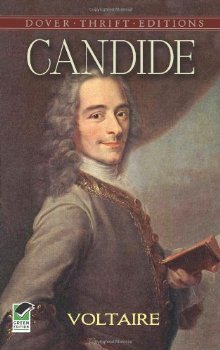

P - Preferred Place to Read 
Anywhere quiet.
A steady hum of sounds is OK. Jabbering, cell phone conversations, sitcoms, etc.? Not.

Q - Quote That Inspires You or Gives You All of the Feels From a Book You Have ReadObviously, Candide: "That is very well said, but we must cultivate our garden."

R - Reading RegretOther than maybe Cynthia Ozick, nothing I've actually read, but more all the time I've wasted not reading in this life.

S - Series You Started But Need to FinishSome people would say Harry Potter (I've read the first half of the first book...twice...)  Definitely not Sue Grafton's Kinsey Millhone ABCs, as I am So done with  all that. Let's see, what could it be? I haven't started Game of Thrones, really, though I did read the first few pages of the first, and that's my next-up series, I believe...I can't really think of any. Wait, Alafair Burke's Samantha Kincaid and Ellie Hatcher books are series, right? But she's still writing, and this is supposed to be a complete series. Ugh. Can I use Proust here, too?  Well, wait, actually, I think Alafair Burke is done writing Samantha Kincaid, she said, now that she's in New York. And I've read two of the Portland-set Kincaid series and need to read the third. So, that.

T - Three of Your All-Time Favorite Books(You see where I've already mentioned Candide and War and Peace multiple times, right?)
How about:
Lonesome Dove by Larry McMurtry
Pilgrim at Tinker Creek by Annie Dillard
Man's Search for Meaning by Viktor Frankl

U - Unapologetic Fangirl For...
Um.
Fangirl? Me? Ummm...
Anna Quindlen?

V - Very Excited for This Release More Than Any Other
 
Would it just be wrong to say my own book?
I'm so not the release-anticipating type with books. I've fallen behind on all my still-writing living authors (Atwood, Berg, DeMille, et. al.) I've got one word for you, kid: classics.

W - Worst Book Habit
Sitting here with a laptop on my lap instead of picking up a book?
Judging people who read trash?  (I mean real trash, like Twilight; I'm not disparaging the genres here.)
Disparaging genre fiction?
Forgetting what I've read?

You tell me; which is the worst?

X - X Marks the Spot: Pick the 27th Book on Your Bookshelf (from the upper left)
Dashiell Hammett, The Maltese Falcon

Y - Your Latest Book Purchase
Pretty sure it was at Schuler over Christmas when I picked up Night Train by Martin Amis and Game of Thrones by the inimitable conscientious objector George R.R. Martin. Have I bought anything since then? I don't think so. I tried to get Vanity Fair at our neighborhood bookstore in Lincoln Square, The Book Cellar, but couldn't find it, and at Women & Children First, I tried to get our next book group book, Eichmann in Jerusalem,  and they were sold out of that! So, back to the library...

Z - ZZZ Snatcher: Book That Kept You Up Way Too LateThis has not happened in SO long. I am a champion of falling asleep these days. I love getting sleep. I can't remember staying up reading, sucked in, since I was in Andong (Korea, in 2011)...either Freedom by Jonathan Franzen or Long Gone by Alafair Burke; I remember being up late reading both of those that year.

What a fun survey!

How about you?


Thursday, January 08, 2015

Check-in time
A look at what 15-year-old me declared she would read...

In case anyone thought this whole making-lists-of-books-I-want-to-read habit was a new thing or started in adulthood or (god forbid) a Goodreads-inspired internet solution (in that last case, you should probably go read To Save Everything, Click Here and stop thinking about the internet as the only and ultimate solution for everything), we have actual evidence to the contrary. I have here an old notebook from my junior year of high school in which I wrote some goals for the New Year, including the aspiration to "read 100 books (as in, good ones)."  I'm terribly curious as to what kind of unworthy books I thought I would  be tempted to read that needed to be excluded from the list...young adult, maybe? *smirk*.. but in any case I then gave some examples
of what I should read. Here's the list, from my 15-year-old self to you:

  • The Scriptures
  • Les Miserables
  • Jesus the Christ
  • A Marvelous Work and a Wonder
  • To Kill a Mockingbird
  • [The] Catcher in the Rye
  • Uncle Tom's Cabin
  • Wuthering Heights
  • War and Peace 
  • etc.
Gotta love the "etc."  Couldn't be bothered to actually list 100? Or is it because I reached the end of the page? The top of the next page of the notebook begins with a new topic, "WAR." Oh, yes, I was me. Gotta also entirely love that War and Peace made the list. I feel satisfied knowing that even at such a tender age, I was fully aware of my destiny. Great stuff, teenage Linda. (Who was at that time, as evidenced by some of the more Christ-y entries on the list, most assuredly still a Linda With Borders, eh?) 

So, then?? Status report? Well, here we are two decades later and I have completed more than half of that list, but not quite all. I did apparently start at the beginning, because I remember that school year I indeed delved into scripture (and yes, I did read The Whole Thing, though it took a few years) and Les Miserables. I am terribly sad to report I read only about 250 pages of that long novel (obviously, unabridged; what do you take me for?!) that year. Well, guess what, it is totes on the 2015 list anyway, for me and Brian. How about that! What else? I read The Catcher in the Rye later, during the summer after my senior year, then finally got around to  Wuthering Heights and To Kill a Mockingbird a few years after that, in adult life. In Boston, I read a good chunk of Uncle Tom's Cabin, maybe 100 pages or so, but didn't finish, and of course we all know that in 2005 I had the good sense to tackle War and Peace. I wonder if I ever read much of Jesus the Christ and A Marvelous Work and a Wonder...hmmm. I know I've touched those (and they're still on my mom's bookshelves to this day) but nothing sticks with me, and I can't say I have any interest in reading them now. The Mormon General Authorities and higher-ups are kind of like tenured professors, I think, in their writing. They might be technically competent and even have interesting things to say, but they're not really inspired to write a book so much as they are compelled by their life situation to write about their topics of expertise. And we all know how I feel about reading academic journal articles that are more concerned with citation than narrative.

Now, about that "etc."...

Tuesday, October 14, 2014

If you can't hold on, hold on

finished: Time's Arrow by Martin Amis

Because the Holocaust doesn't make sense, how to make sense of the Holocaust? 

How can you write about it? How can you write a novel about it? Lots of people have, of course. How do you approach it?  You can't make sense of it. Can you try? 

Martin Amis has taken some flak for writing Time's Arrow. Some of it was how-dare-you-write-about-the-Holocaust-you-weren't-there. I'm not sure I find that point very convincing. Some of it was your-telling-of-the-story-backwards-is-just-a-gimmick. Some of it was you're-the-same-old-Martin-Amis-as-in-your-other-novels-and-I-like-to-bash-you. On the other hand, some reviewers apparently fell all over themselves to praise it when it came out in the early 1990s, what with its heavy, important subject matter, and Amis' important self. (Word order chosen carefully there.) 

I came later to the Martin Amis party. I'm pretty sure I'd never heard of him when I was in high school. I had heard of his pops, Kingsley Amis, by the time I finished college, but it was working in a bookstore that really put Martin on my radar. I got around to reading him for the first time in 2007, when I commenced my A-to-Z project, in which I read and blogged about a book by 26 new-to-me authors, one for each letter of the alphabet. I started with him, for 'A'--I read The Information and loved it. A couple years later, after making my way through the alphabet (hey, I was in law school--and besides, I always have lots of other stuff to read; it's never just one project at a time), I decided to select the Top Half and read another thirteen books by each of those authors. Amis made the cut. I then read Money. And, as time has marched on, I've continued by selecting six of those thirteen and reading a third book by each of them. Yes, Amis is in this select group of A-to-Z project semi-finalists, along with Truman Capote, Umberto Eco, E.M. Forster, Salman Rushdie, and William Styron. And this time around, my Amis selection was Time's Arrow.

Interestingly, this summer as I read third books by the likes of Capote and Styron and Amis, I was also preparing for my Habitat trip to Poland (which you can read more about here and here and here on my front page blog). And interestingly, it just so happened that I had months earlier, when I didn't yet know I'd even be going to Poland this year, acquired Time's Arrow for my Amis selection (at our favorite bookstore in Seoul, during our January layover) and decided to finally read Sophie's Choice for my Styron #3 (a decision made whilst we were still living in China). So there I was, in Michigan this summer, reading Sophie's Choice and also preparing to go to Poland. Naturally, I sought out some Polish literature by Polish writers at the library (all hail the GRPL!) and read stuff about the history of the country, too. But I also, in yet another twist of fate, happened to find myself this summer on Franklin Roosevelt in my read-a-bio-of-every-president project. It all came together. And what with Time's Arrow being a light, thin quality paperback, I brought it with me to Poland. 

There, I visited Auschwitz. 

I haven't yet shared with the world all my Auschwitz-visiting thoughts, of which there are many. It was such a mind-altering experience, being there. Here, let me just say this: I was so glad, when I read Time's Arrow the next week, that I had visited Auschwitz before reading it. 

To be honest, I wasn't all that fond of Sophie's Choice. I've seen the movie, years ago, so I knew all about the choice and the things that happen. And it seemed crazy that I didn't like it, because I have been so enthralled with my boy Styron up to this point, reading his earlier (more obscure?) stuff, like Lie Down in Darkness (my favorite book of the original A-to-Z 26) and Set This House on Fire (such a book for self-indulgent expat writers who think they have something to say to the world...)  But I thought that, frankly, Sophie's Choice totally failed. Styron's approach (gimmick?) was to narrate as a writer telling the story of Sophie, his friend whom he meets after the war, living in Brooklyn. Then she/the narrator recount her experiences in flashbacks, but they're all over the place, and the sexual overtones of it all are kind of abhorrent, frankly. Sophie desperately needed/needs to be rescued, but instead she continues to be taken advantage of and ravaged, by life and everyone. And everyone is a mess. Sure, these cynical things approach a truth about humanity, too, but they didn't really tell me the Holocaust/Auschwitz story it seemed Styron was trying to tell. 

Amis' approach was to get inside the mind of a former Holocaust doctor -- and I do mean, as a separate entity, who has somehow appeared inside the man's mind -- and go backwards from there. I thought Time's Arrow was incredible, and I admire it and Amis because he succeeds at demonstrating something for us. It's easy enough to say that only in a crazy, mixed-up world where time flows backwards could the Holocaust make any sense, but its another thing to write the novel that shows that. As we travel backward through time and through the life of Dr. Tod Friendly (and his several other later/earlier names), we know what's coming, and we read about him and his fellow Nazis "creating" a race of people out of fire and ashes. We all say that the death camp Auschwitz goes against all that humanity is. You certainly feel that during the portion of your tour when you step into the chamber that was once used to gas prisoners in the hopes of exterminating the Jewish people (along with hundreds of thousands of others). You can feel that again when you read Time's Arrow

When the backwards-running narrative finally arrives at Birkenau, you remember walking along that Birkenau train track, looking up at where it dead ends at the edge of the forest. Shit, you think. This world needs to be grappled with. You think that when reading, and when visiting. 

The story is basically too much to tell (not that we shouldn't try), and the "gimmick" of telling it backward turns out to be less gimmick and more way-to-access-this-thing. 

I read a biography of Martin Amis this summer, too. It was a light, I-think-just-this-side-of-unauthorized account, but it was interesting. Basically, I am jealous of Martin and his literary friends (Rushdie, Hitchens, Barnes, and the like, all those England Observer-writing literary intellectuals who get to just hang out being readers and discoursers together and writers when they are alone all the time) and I want to inhabit such a world (but hold the incessant womanizing, eh?) I read with interest about the friendships developed with Saul Bellow and the occasional arguments over Israel/Palestine politics. I must say that in a way, Israel/Palestine politics have nothing to do with the Holocaust. To equate critical analysis of Israel policy (or U.S. policy) with anti-Semitism and therefore "forgetting" (as opposed to, you know, never forgetting) is I think as insulting as what it's trying to insult. How can you make a political military issue out of this total affront to humanity? 

My incredible tour guide at Auschwitz said that the longer she works there, the less she judges people/countries/leaders, such as the Allies who opted not to bomb the railways leading to Auschwitz, and the more she remains neutral as she learns and is glad she wasn't in the difficult position of making those decisions. This is a woman who routinely communicates with Auschwitz survivors, and she shared some of their thoughts with us. She was steady, somber, and very informative. We walked around on a gray, drizzly day, through the mud and dirt, through the exhibitions, around the remains. Nothing makes sense. She explained it all to us, and the facts and exhibits and piles of eyeglasses and shoes make no human sense. But there they are. 

It's not about reserving judgment, or not taking a stand, or not believing in what's right. Backwards, we can approach this event with all the knowledge and all the judgment and all the pain, and see what we can see. We (humanity) obviously didn't see the Nazis when we went in chronological order, so Martin helps us by approaching them the other way. 


Sunday, June 02, 2013

He was a warmongering Nobel Peace Prize winner before warmongering Nobel Peace Prize winners were cool

recently finished: Colonel Roosevelt by Edmund Morris

This book, the third in Edmund Morris' fine trilogy depicting the life of Theodore Roosevelt, gives a reader the chance to ponder many important life questions, such as: Who have been the best among the 43 (yes, you read that right, 43) U.S. presidents? What makes a man or woman truly great?  and Why ever do we pronounce a word spelled co-lo-nel as "ker-nel"?

Well, like it or not, he is "the Colonel" through much of this third book, after the second volume about his presidency and the first about his pre-presidency life. Volume 1 won the Pulitzer and may be the best of the three in the eyes of many, but I think in the end I enjoyed Volume 3 as much if not more. Volume 2, oddly, was less interesting in a way. The actual stuff that went on during Theodore's (not Teddy!) presidency was fascinating, obviously, but it was as if Edmund had way too much source material to work with. He is at his best, I think, covering the less already documented portions of TR's life, because Edmund is a master of pulling together tidbits from the deepest archives and combining that with incredible feats of personal travel research to complete the portrait of his bio subject.

In Colonel Roosevelt, Theodore is out of the White House, where he has cajoled and coerced and manipulated my boy William H Taft into taking his place, although he ends up abandoning Taft in a totally rude and in my opinion avoidable falling out. Taft did not want to be there, and Theodore was an unnecessary jerk about it, and Taft even asked for TR's help, but Theodore was all high and mighty and hanging out with every king in Europe and, I daresay, realizing that he himself could in fact be president again in 1912, perhaps, and therefore he became unwilling to help Taft. So rude. Well, the plan failed. But it's a fascinating chapter in TR's life (and several chapters in the book).

The other highlights of Colonel Roosevelt are travel and war. Naturally, those are "highlights" in totally different ways, and only one because it happened. The other, clearly, is interesting to read about but in real life avoidable, although no one will ever learn, particularly not when they are giving the Nobel Peace Prize to warmongering presidents. This book starts with TR's amazing African safari hunt (the man is nothing if not bloodthirsty, despite his mid-life epiphany that he maybe shouldn't kill off all of the animals he would like to keep around for future generations) and I actually could have used a couple more of Edmund Morris' fabulously cute little maps that he (the author himself!) draws to show us TR's life journeys throughout the three volumes. Then, later in the book, we get yet another epic journey, again bringing his son along, this time to Brazil and uncharted areas of the Amazon rainforest to map a new river. (Not precisely "new" seeing as one of the animals in their party is felled by the arrows of Indians who may have never seen the white man before, but you know, new-to-the-Brazilian-English-Spanish-Portugese-United States-ian-etc.-maps kind of new. Unsurveyed.)  That there was one trip full of hardships, up to and including death, and also some of the most powerful bonding of human friendship to be found.

World War I is something I and many others should probably know more about. It was good to review the events leading up to it and the ways in which all of the parties (except Belgium! as TR rightly points out) were both partly justified and partly at fault in starting the giant, menacing debacle. There were some sane voices trying to solve problems in a better way, but there were also lots of voices like Theodore's, positively salivating to go to war (despite his being BFFs with the Kaiser and other Germans). Presidents Taft and  Woodrow Wilson both were interested in peace, and took major steps to try to have peace, but boy do I understand what a hard struggle that is in this violence-lusting world of ours. Quite honestly, Wilson might not have really taken the best approach, what with his whole kept-us-out-of-war being so U.S.-centered and all that it really doesn't help bring about world peace. I do wish Taft would have been able to get his world peace body of nations together, but alas, the world started slaughtering in new, ever more advanced technological ways, and TR packed off all of his sons to Europe to join the "fun." Or should I say doom?

As usual, a feeling of sadness came over me as I pushed through to the final chapters. All of my presidential bios end the same way! as I like to joke. I could see the end of TR's life approaching, so I poured a glass of wine to settle in for the demise. After three months and three books, I do know him well, and I commend Edmund for this remarkable achievement, although I still can't believe TR's sister got married in an endnote in volume 1 after her personal life, its intertwining with TR's, and her lack of marriage were major plot points for hundreds of pages before that. The endnotes are definitely something to grapple with in this bio series, almost at the Infinite Jest level. (OK, well, not quite.)  At any rate, if you're one of those who has often wondered just why the heck Theodore is carved on Mount Rushmore with those three other biggies, plunge into Edmund Morris' magnificent life's work about a life.  Overall: A -
The Rise of Theodore Roosevelt: A -  Theodore Rex: B+  Colonel Roosevelt:

Saturday, October 13, 2012

Trouble With the Karamazovs

now finished: The Brothers Karamazov by Fyodor Dostoevsky

Reading the same book for a month? Wishing I had more time to devote to it? Folding down pages and lamenting my lack of ability to read in the original language? Ahhh, must be time for another Big Russian Novel.

This one was destined to be anti-climactic. I've been meaning to read The Brothers Karamazov for SO long. I kept trying to persuade my Los Angeles book group peeps to read it (L.A.! That's so many cities ago!...although I need to go back there, by the way) when we had our The Books We Should Have Read in High School book group. That being said, they were probably right about not reading it at that time; I guarantee we would not have had a 100% successful finish rate. And, I no longer think of this as a Book We Should Have Read in High School whatsoever. College, maybe, though. In fact, college definitely. It's that kind of book. I probably would have loved it in college. I didn't really love it right now. I thought it was long-winded.

Now, recall that you are reading someone who absolutely loves her some long Russian novels. (And short Russian novels, but aren't there fewer of those?) Who read Anna Karenina (the whole thing! really!) in high school. Who considers reading War and Peace one of the top five greatest life experiences. Who has often pondered how Russia, much like the American South, does it -- how those two places crank out so freakin' much good literature, although they never make readers actually want to live there or anything.  Long is great. Long-winded is quite another thing. I'm not entirely sure that Dostoevsky edited this book at all.

It turns out that The Brothers Karamazov should be even longer; he was planning to write a three-part saga, but he died. This was his final novel. I kind of see him as this old man (even though he was only sixty-ish) with a life's great work behind him so everyone just lets him write and create and do whatever he wants in his art, without trying to stop/edit/finesse him to make it better. Kind of like Clint Eastwood does now. We don't really demand anything of Clint anymore; we just take what he gives us and continue to praise his genius. I think Dostoevsky was kind of rambly in the Brothers but no one cared. Why not? Just let it all wash over you. (No word on whether he kept an empty chair around to stimulate discussion.)

So, there are a few great things about the book. One, he has this crazy ridiculous insight into the human mind. So you can actually get through the book on that alone, marveling at the way these flawed characters are depicted and delighting in some of his pithy summaries of thought processes that are a bit like Kerouac's in the way they make you think, "Wow, he finally said what my brain has been trying to say for twenty years."

But then you kind of want the plot to go somewhere instead of reading five mystical pages about what place love and Christ and death have in our jacked-up world...

Eventually the plot goes places, of course. I frankly think the book got really good around page 500. (I am aware that this is FAR too much to ask of, oh, most readers.) And despite the fact that SO few people read this blog and even fewer are planning to ever read The Brothers Karamazov, I just can't offer up spoilers, which means I can't talk about huge, gigantic, major, point-of-it-all happenings like "whodunnit" and why.

I can say that Alyosha was annoying at first, but then I really got to like him, once I kind of understood him. Dmitri seems like a big jerk, but once you tap into his confusion you start to understand him a little better, too. Ivan is presented as all dark and dismal and atheist but I kind of liked him more in the first place than I did the others.

Another great thing about this book is that there are definitely great quotes. Like:

"...you, I, all of us are in a state of aberration, and there are ever so many examples of it: a man sits singing a song, suddenly something annoys him, he takes a pistol and shoots the first person he comes across, and no one blames him for it."   --p. 528, ISBN: 1-59308-045-X

He wrote that line in 1879, kids!

Speaking of the edition I read, I would really like it if the Barnes and Noble Classics edition hadn't told me a major plot point on the back cover. I mean, I guess everyone is just kind of expected to know what the book is about, but I am still of the belief that anything that happens after three hundred pages should not be on the back cover, period.

Basically, this book is really different from Crime and Punishment and Notes From Underground, my two previous Dostoevsky endeavors, both of which I loved. This book is more winding, more overtly philosophical about Big Questions (is there a god? what is family? what is love? death? society? justice? and so on), more pointless in some ways (Ilusha and Kolya Krassotkin....why? just, why?), and definitely more long-winded. Which, I already mentioned that.

However, I will say one thing: this book would be really hard to fake. The experience of it is quite different from its fame and all you hear about it in the world. I think one could fake The Scarlet Letter or Moby Dick or Hamlet a lot more easily. The Brothers Karamazov is really famous, but what do we know about its details in the world? It's about a family. With brothers. It's big and Russian. It's full of ideas and peasants and society. 'Cause it's Russian. With brothers. This, my friends, barely scratches the surface. As much as I think Moby Dick is utterly wasted on high school and college students and has so much more to say to adults who are disillusioned with life in the workplace, I still think the famous ideas about The Whale match the book itself, more or less. Not so with this book. So that's my advice to you: if you are one of the millions who has not read this book, don't try to fake it to impress that potential date at the bar who adores it. You will be called out faster than you can say Smerdyakov.

Monday, September 17, 2012

Highly recommended alert: Shalimar!

now finished: Shalimar the Clown by Salman Rushdie

I hadn't really planned to read Shalimar the Clown. Careful readers of this blog(and even some of the half-assed ones) will recall that Salman Rushdie was my 'R' author in my A-to-Z Literary Blog project, wherein I read a book from each of 26 new-to-me-but-famous-and-I-always-meant-to-read-them authors, one for each letter of the alphabet. (Mostly. Sorry, Gao.) For my first Rushdie, a few years back during the project, I read The Satanic Verses. (Um, it was weird. Good, but weird. And anyone who wants to kill an author for writing a book is a stupid worthless stupid dumb jerkity jerk, end of story, but no, I did not see anything in that book worth getting outraged about.)  Now, I am deep into my A-to-Z Top Half project, wherein I chose my 13 favorite authors of the 26 and am reading a second book by each of them. I have only a few left! So, here I am in Mexico, with less access to the books in English than I normally would have, so I asked some of my fellow expat reading peeps around these parts if they had any Salman Rushdie, because that's a pretty likely thing among travelers/English teachers, unlike some of my other A-to-Z top half authors (I'm looking at you, Warren-Styron.) I pretty much just assumed someone would have Midnight's Children, but instead, I was loaned Shalimar the Clown.

Well, guess what? It's awesome. I mean, seriously awesome. Its awesomenes sneaks up on you, too, so you're going along about page 350, 360 or so, and you've been caught up in these characters for a while, and you've learned a lot, and you REALLY want to go visit Kashmir because it just sounds heavenly, and you really like what he did with his descriptions of L.A. in the first chapter, and you totally dig lots of the characters who live in these two villages, and you are starting to think about big global issues because you see how its all coming together, and - wow! It hits you. This is going to a really awesome place, isn't it?

Of course, it's horrible, what happens. Because revenge is horrible, but specifically, death as revenge is horrible. And no, I am not spoiler-ing, because said murder happens in the first chapter, but then you learn more about it for the rest of the book. And you learn about a million other things besides. Among them: on what grounds would you, yourself, kill. To save your own life? Your family's? Your country's?  What about to save those entities' honor? Ahhhh, the lines we draw.

Salman Rushdie is, of course, awesomely equipped to write about this subject, being the object of the horrible stupid horrible nonsensical violent murderous horrible fatwa and all. But he doesn't hit you over the head; like I said, the awesomeness of the big questions sneaks up on you.

As I mentioned in my Goodreads review, this book should be required reading for everyone in the post-9/11 world, but unfortunately, so many people just would not get it.

Monday, June 04, 2012

Is a war best served cold?

now finished listening: The Dead Hand: The Untold Story of the Cold War Arms Race and Its Dangerous Legacy by David E. Hoffman
next up (audio): The Last Gunfight: The Real Story of the Shootout at the O.K. Corral--and How It Changed the American West by Jeff Guinn

Speaking of not starting the fire (which I did in my last post on this blog), after several months of listening during walks and hikes, I completed my latest audio book, The Dead Hand: The Untold Story of the Cold War Arms Race and Its Dangerous Legacy.

This is a perfect example of the non-fiction subtitles I used to make so much fun of back when I first started working at Borders. It's like, people! You get ONE chance to title the book, OK? Why should you get to title it one thing and then go ahead and put all the things you were trying but failing to convey in your title in a second, sub-title? That bugs me for some reason.

Anyway, I realize that people do not necessarily know what The Dead Hand is, so I am here to tell you that it refers to the Soviet plan to build a facility way below the earth with automated systems that could launch nuclear retaliation in the event that the U.S. wiped out the Soviet Union with nuclear weapons. That is, instead of a hand on "the button" launching a nuclear weapon to attack the U.S., all the Soviets would actually be dead but it is like a dead hand holding down the button, launching the Soviet missiles as revenge to the U.S. I am fairly certain that the author is appalled at this very notion, based on the way he talked about it and chose to use it for the title of the book. However, I think that's unfair. This is something that specifically would happen IF and ONLY IF the United States first wiped out the Soviet Union and there are no leaders left alive. I mean, if you're going to be all wtf?!! about it, you might want to at least consider that the U.S. is the truly dastardly one in that scenario.

This book isn't biased in a Fox News way, but it has a hint of that assumption of U.S. rightness that bothers me because I feel it caters to people who accuse anyone who criticizes the U.S. of being a commie or terrorist or whatever. I do give major kudos to David E. Hoffman for pointing out that Mikhail Gorbachev is truly awesome, a smart, even brilliant, leader who deserved major accolades for all he did in history. I love my boy Gorbie! This book also offers a bit of a glimpse at Ronald Reagan's fretting that bordered on paranoia and the fact that Reagan's use of phrases like "evil empire" didn't help matters any.  (Reagan himself reconsidered and later regretted using this phrase, especially once he got to know more and more Russian people.)

Alas, like so much of our public discourse in the U.S. among squawking heads and on the interwebs and whatnot, no one ever considers that the U.S. could actually just be a bad guy, or, even, an average guy who is equally responsible for the stupid-ass nonsense that is war and/or cold war. And that pretty much seems to be David E. Hoffman's position in this book: that the Soviet Union was horribly sinister, secretly making biological weapons and plotting to destroy the world.  He seems to pretty much miss his own (well documented) point that the people who were working in those factories and labs were completely and totally under the impression that the U.S. was also manufacturing biological weapons in violation of international conventions. (Convention as in "signed treaty," not as in "mannerly custom.")  Hoffman spells out how many of the scientists and other workers were decent people and hard workers who were often uninformed and at worst misguided, and even points out how Gorbachev was in the dark on some of this. So why can't Hoffman acknowledge that the U.S., too, occasionally does horrible things because of a few power hungry people who force, cajole, or brainwash others into doing their bidding?  (Exhibit A: Guantanamo. Exhibit B: Iraq. Exhibit C: Taxi to the Dark Side.  Exhibit D: Vietnam.  I could go on...)

And then there's the possibility that the U.S. in fact was also secretly testing and experimenting with various sorts of weapons over the last few decades.... Who, us?! Never, right?  Give me a break.

That said, you can totally learn a lot from this book and it is really, really interesting!  It might be particularly useful for children of the 80s such as myself who came of age as "communism" "fell" and whose introduction to the world of news, government and power was filtered through now-iconic images of Reagan and Gorbachev doing their thing.  Many of the individual Soviets' stories are also fascinating, as are the bits about the "mysterious" anthrax outbreak in the Soviet Union, the off-course Korean passenger airliner shot down because Soviets thought it was a U.S. spy plane (why? because a few months earlier there HAD BEEN an incident there with a U.S. spy plane going over the line, even though we are all innocence and goodness and light of course), the defectors, the flock of geese mistaken for a missile, the George Bush (I) administration that threatened to undo all the good of Reagan/Gorbie, and the tours of the U.S. in the early 1990s in which Soviet verifiers would insist on stopping on some random highway in, like, Kansas or Alabama to check a water tower that they were sure must be holding some biological weapons....but nope, just a water tower.

The Dead Hand is a fascinating book and it won the Pulitzer in 2010 for General Nonfiction. I highly recommend reading it, but I can't highly recommend listening to the audio. I know I am finicky about my audio listening (I have only recently started being able to listen to audio books, while I walk or exercise, and even now I can't listen to fiction -- I hate being read to) but I really didn't care for this narration and it made the book less compelling of an experience for me. I couldn't wait to get back to my favorite narrator (yes, I do have one, and I am pretty much choosing all my audio books right now by only getting ones that he narrates, which unfortunately did not include The Dead Hand.)

Hey, how about we all give peace a chance and stuff?


Thursday, May 24, 2012

The Island of the Day Before

now finished: The Island of the Day Before by Umberto Eco
Umberto Eco was one of the sure bets in my A-to-Z Literary Blog Project to make the top half, in which I am revisiting my top 13 authors by reading another book of theirs. The book I read for 'E' is for Eco during the original project, The Name of the Rose, was so perfectly what I expected it to be -- including interesting and good, along with much more -- that I became convinced he would continue to be perfectly what I expected of him in his other works. I had always thought I'd read Foucault's Pendulum  next, it being so "the other book by Umberto Eco" famous and all, and I've even touched it many a time, but instead I am in hanging out in Phoenix and my local branch of the library had The Island of the Day Before on the shelf and I was there and could have put a request for the Pendulum to be transferred from another branch but The Island of the Day Before was about a man shipwrecked on a ship, and it was blue...so blue...I like blue things...

OK, so this was a strange book.

I can truly appreciate the Goodreads reviewer who referred to its "150 page screening process to weed out the unworthy."  I really did not know what was happening for quite some time and I wasn't sure if I was enjoying the book at all, but it ends up getting kind of trippy and good, at least in parts.

I know, I know, it doesn't sound like a very enthusiastic recommendation, and there are so many of you who are all like, "I ain't gonna work to read a book" and that's fine, just go on back to your Hunger Games, now, really. Run along. Umberto Eco melds philosophy and whimsy and wink-wink cleverness and social criticism and story and literary allusions (including to himself) and some weirdness and some history and god knows what all else. There is no "OMG I literally hunger for these games" here.

Sometimes The Island of the Day Before is straightforwardly clever, such as when Roberto della Griva's father advises him, "Well, war's an ugly animal, that's sure. Anyway, my son, never forget: always be good, but if somebody comes at you and means to kill you, then he's in the wrong. Am I right?" - p. 51 

Sometimes it's wry:  "He was now so sure an Intruder was on board that his first thought was this: Finally he had proof he was not drunk. Which is, after all, the proof drunks constantly seek." - p. 200

Sometimes there's a kind of winking sympathy directed at the reader: "We could say that Roberto had definitely lost his mind, and with very good reason; no matter how he calculated, the figures would not add up. The paradoxes of time can indeed unhinge us." -p. 338   This basically sums up the experience of the main character and yet also the reader of the book.

I personally think the book became excellent when he started philosophizing with Father Caspar about religion, swimming, the universe, and so on.

And really, who else but Umberto Eco could use the word "hircocervi"? I mean, sure, he wrote in Italian and the translator used the word "hircocervi," but the Italian could very well be the same, and I'm sure you get my larger point. Who writes about hircocervi, mentioned in a passing metaphor? Umberto Eco, that's who.

Have I mentioned that the ship on which Roberto della Griva is shipwrecked, as well as the island he can see but can't swim to, as well as the story he is writing, as well as a few other things are these incredibly layered metaphors?  Have I mentioned that "the day before" refers to the international date line, which thoroughly trips out our hero Roberto, as he thinks about the ramifications of swimming to yesterday?  Have you ever thought about how central figuring out longitude calculations can be to life on Earth as we know it?  These days, we see how nuts some religious folks can be about evolutionary biology, dinosaurs, and prayer before football games. I thought about that as our characters grappled with what longitude says about papal conceptions of Earth's place in the universe, and as they matter-of-factly discoursed on whether God created infinite worlds and the meaning of atoms, The Void, and all being essentially being nothing.
 
Some books are easy to talk about. This isn't one of them. I enthusiastically recommend this book, but unlike The Name of the Rose, the list of  people to whom I'd recommend this one is pretty small.

Page numbers I cited are from ISBN 0-14-0259198

Monday, June 26, 2006

It is finished

I have returned from Korea.

I finished reading War and Peace on the plane, somewhere over the Pacific Ocean. Now, wouldn't you know that my seatmate to the right on that long flight would be a man from Serbia with some Russian heritage who was most intrigued to see me reading Tolstoy, and to learn that I had read other Tolstoy as well as other Russian authors. I thought - really? Are we known as such plebes that we aren't even thought to have read phenomenal Russian literature? I'm such a fan of Russian lit. Dostoevsky and Nabokov and then there are gems like The Master and Margarita by Bulgakov...anyway, I digress.

I finished the book!

I also finished my stint in Korea.

The Serb/Russian man asked me what one main point I would take from the book. One? I was incredulous. But I said, after a moment's reflection, you know, it's that there is something bigger than us all guiding this whole thing (life).

And it's not simple. It's not simply "God." Tolstoy, they say, did come to terms with Christianity in his way. But I mean, the epilogue just went on and on about this philosophy he's been sprinkling throughout the book about historical events; the free will or lack thereof of kings, generals, and so forth; the interconnectedness of it all; and how the farther we get from events in history -- or in our lives, I daresay -- the more sense they make.

Needless to say, I had a fabulous plane ride home. Sooooo much thinking. I can honestly say, between the comfy seat (in the big middle five-seat row, but the bulkhead gave some leg room) and the many things I had to contemplate contending with upon arriving back on U.S. soil, that I wanted that journey to never end.

Thursday, May 25, 2006

Drawing near the end

I love Natasha! Why? I don't know!!! Pierre, too. And I LOVE the philosophizing Mr. T continues to engage in as the French army flees and falls apart and the Russian army falls apart too, for good measure.

I have a mere 160 pages left to read.

I have a mere 16 days left in Korea.

Monday, May 08, 2006

Restructuring

Besides this, the entire staff of the Russian army was now reorganized...Very serious consideration had to be given to the question whether it would be better to put A in B's place and B in D's place, or to put D in A's place and so on--as if anything more than A's or B's satisfaction depended on this. - pp. 1183-1184

I dare say that reminds me of a Borders restructure or two!

Lately some of my friends and co-workers here have seen me with my tattered copy of The Book again, and this makes them ask the perfectly logical question: "Aren't you done yet?" Well, perhaps not perfectly logical, seeing as if I WERE done I likely wouldn't be carrying it AROUND now would I? But yeah, today was the first day in weeks and weeks --like maybe six or seven of them--that I've taken the book to work with me in my backpack and had time to read a bit in the coffee shop during my afternoon break. And there probably were things I could have been doing for the play as I sat sipping my cappuccino, but I read instead.

Also, I have received my first official "I'm done" from a friend back home who took the plunge, and that's scary. He totally kicked my butt! I still have 200 pages to go! I would like to point out that he needs to comment a bit on here though, now that he's DONE.

But only comment up to page 1200! Don't tell me what happens!!!


Monday, May 01, 2006

I'm the decider!

Napoleon, with his usual assurance, not that what was right was right, but that whatever entered his head was right, wrote to Kutuzov the first words that occurred to him, though they were utterly meaningless. - page 1182

Of course, then the exchange that follows between them does nothing to bring about peace. But Moscow and the citizenry and the army -- and Tolstoy -- are still regrouping and reckoning with Borodino and the march of historical events. It's taking me an exceedingly long time to read this part. I'm on the page-a-day plan. I am just too busy. My afternoon coffee shop time is now entirely given over to doctor appointments, play preparation/rehearsals, or some combination of these. At night I fall into bed and am lucky to get through one page before falling asleep! So maybe I won't even finish The Book before leaving Korea!

But don't we all know someone like Napoleon?

Or, as Ani puts it, "everyone is a fucking napoleon." Well, not to put too fine a point on it:

Now you think, so that is the way it's gonna be
That's what this is all about
I think that that is the way it always was
You chose not to notice until now
Yeah now that there's a problem you call me up to confide
And you go on for over an hour 'bout each one that took you for a ride...
- Ani DiFranco, 'Napoleon'

Her song is actually about the music industry, although it's also about a lot of other things, of course.

We expats over here are intrigued by tales of massive immigrant protests and political uprising back in the States. I heard on the AP Radio News a wonderful Bush sound bite. In response to the new Spanish version of "The Star-Spangled Banner" he was saying people who want to be U.S. citizens ought to learn English. He said, "And they should learn to sing the national anthem in English!" And the way he said it was just so classically -- Bush! Faux folksy, adamant, a slight feel of bewilderment. I couldn't help wondering if he can sing the national anthem. No one can sing the national anthem! Or if he knows all the words. I remembered Ramona Quimby's "by the dawnzer's lee light" as she puzzles over it and decides a dawnzer must be a kind of lamp.

And so time marches on, as do we all. Armies are on the move; emperors are born and emperors die, and their empires often do the same, if it takes a bit longer.

To recap for those who missed it, I would like to point out that, yes, I have just quoted Leo Tolstoy, George Bush, Ani DiFranco, and Beverly Cleary in one blog post. Imagine all four of them as guests at one dinner table!

Friday, April 28, 2006

Wow...

Oh my goodness! Prince Andrei! What?!?! Andrei...Natasha....wow. So amazing...pages 1172-1177...so amazing...

Monday, April 24, 2006

"The man who will not give his name"

Pierre felt himself to be an insignificant chip fallen between the wheels of a machine whose mechanism he did not understand but which worked smoothly. - p. 1149

So, the question is, will it be Sonya and Nikolai or Natasha and Andrei?

I personally think - I think? - it will be Natasha and Andrei. Not that my personal parallels and cosmic signs I've been taking from this book have anything to do with that, who, me? No! ; )

But if that's true, I do hope Mr. T. has something waiting in the wings for Sonya. I feel bad for her.

I named one of the girls in my advanced conversation/writing class "Natasha" last week. It wasn't particularly a War and Peace thing, but I do love that name. In German class in high school, my name was Natascha, a slightly different spelling. Well, last week the kids in this class, whom I adore and will miss terribly when I depart and who have great conversation skills and write me fantastic compositions every time, asked me for new English names. They were bored, after years at Ding Ding Dang, with their "Tony" and "Tom" and "Carol" and whatnot. Like, every single class I teach has a "Sally" and a "Jenny" and a few "Joey"s and we foreigner teachers are ALWAYS trying to get them to let us pick more original English names when we start up new classes, but it's always this whole long drama and "Oh, they're too hard, the kids can't say them," whatever.

But my advanced kids can say a lot of things! And I teach them many things! And they love me! And I love them! So I was only to happy to give them new names: Torrance, Everett, Wayne, Donovan, Daphne, Angelina, Gisele, Meredith, and Natasha. I looked at them, pondered their personalities, and made my choices. Overall, they're pleased.

But I digress. Oh, Natasha. Everyone in this book seems so special and comfortable to me right now.

When Pierre was on trial, the little riff about trials and interrogations being less concerned with seeking the truth than eking out a desired result was good food for thought.

There are six days left in April. Just thought I'd mention that.

(It may seem this post was not about The Book, really. And yet it was, it was...)

Saturday, April 15, 2006

"They saw everything upside down..."

Poor Ellen! Poor Moscow! And the poor Emperor!

I've slowly but surely been resuming my reading. Dipped a toe in here, done a wrist-deep splash there. This book has truly been my Korea companion. I've gone into hiding, I've gone into a haze of foreigners and activities and late nights, I've gone into a full plate of artsy activities, I've gone into give-work-your-all mode. And with each plunge headlong the book has been with me, mirroring my steady progress. The war keeps marching along, and the peace is always there waiting in the wings.

Moscow's inhabitants have fled to distant provinces and Tolstoy comments that people looking back at that historical period think everyone was engaged in heroic acts. People looking back do not see the personal human interest stories of the moment.

And yet actually those personal interests of the moment are always so much more significant than the general issues that because of them the latter are never felt -- not even noticed, in fact. The majority of the people paid no attention to the general course of events but were influenced only by their immediate personal interests. And it was just these people whose activities were of the greatest service at the time. Those who endeavored to understand the general course of events and hoped by self-sacrifice and heroism to take part in it were the most useless members of society...The law forbidding us to taste of the fruit of the tree of knowledge is particularly manifested in historical events. Only unconscious action bears fruit... - pp. 1126-1127


This book is full of riches. Hoping to take part? I've done that. "Unconscious action bears fruit." Indeed.

Well, Happy Easter! Go in peace.

Thursday, March 23, 2006

Sparkling & Quivering

Napoleon sits on a hill contemplating Moscow, the city he is about to roll into as the citizenry evacuate. He thinks:

"'Yet there she is, lying at my feet, her golden domes and crosses sparkling and quivering in the sunlight. But I will spare her. On those ancient monuments of barbarism and despotism I will inscribe the great words of justice and mercy....And that above all will make Aleksandr smart, I know him.' (For Napoleon the chief import of what had happened lay in his personal contest with Aleksandr.) 'From the heights of the Kremlin -- yes, there is the Kremlin, yes -- I will give them just laws , teach them the meaning of true civilization , and make generations of boyars remember their conqueror with love." -- p. 1046

It's nice when theories turn out correct in life, eh? Such as mine that I would read War and Peace and discover a lot in common between Napoleon and George W. Bush. Hello!

I can hear it now, my trusty copy of The Book crying, "Linda, why hast thou forsaken me?" I can't quite believe it's been more than two weeks since I read and blogged. I'm only 46 pages past where I was then (1000), too. I've been really busy. I have concocted a lot of activities for myself and when I don't have something to do I have been disappearing into the haze of the foreigners watering holes and my English teacher friends and just generally trying to forget the things in life making me uncomfortable. I also have to finish reading the awful book we are doing for our reading group, which meets in two days and I have 200 or so pages to go.

But I just wanted to check in and let the world know that I have found this whole the-wounded-into-the-Rostovs'-house thing fascinating. I am on the edge of my seat about Natasha and Prince Andrei. You had to know it was going to be him.

And besides, my slacking off gives you slowpokes a chance to catch up!!

Tuesday, March 07, 2006

Must hitch up, time to hitch up!

I paused my War and Peace quest this past week. Hitting page 1000 made me realize that I've really been progressing through it at a steady clip, and it will be over before I know it. I am going to miss this little world that I've entered, and I will miss the characters I've come to know, and I will truly miss gaining all my little insights from it. But mostly I will miss just being in it, experiencing it finally after years of considering taking the plunge.

You are welcome to read the above paragraph as if it is about Korea instead of War and Peace. It might well be.

Today I brought the book with me to work, and thus had it with me after work, reading it on the subway to and from downtown this evening. I feel like I'm getting reacquainted with Ellen and Pierre and everyone. Pierre basically left Borodino shaking his head and asking "What the...?" Boy is he going through some emotional-philosophical upheaval!

Tonight on the subway I met a guy from Afghanistan. ! I mean, who ever meets someone from Afghanistan? It was really, really interesting to talk to him. I hope we can become friends. The weirdest thing -- apart from the very fact of having a conversation with someone from Afghanistan -- was that we automatically had something in common being foreigners in Korea. That's how bizarre it is, at times, to be here.

Naturally, the conversation at one point touched on Bush and American soldiers. (Those being two VERY different things, of course.) That was interesting, too.

So Pierre has left Borodino and seems to be ready to just say, what IS this? What are we all doing, and why, and how? Count Rostopchin gets into it with him about the proclamation, and Pierre simply stands there, his expression not changing. I imagine after what he's just witnessed, a little thing like this bigwig warning him off seems utterly ridiculous, although he likely will have to disappear.

Prior to that, with no room at the inn, Pierre dozes in his carriage dreaming of sitting at the table with his benefactor and many others, epiphanic wisdom floating into his brain. Tolstoy captures so well that sensation of waking up and then trying to get back into your dream, and how disappointing it is when the scene changes.

I feel bad for him about his crazy wife, but I did like that he didn't seem to care one whit about indulging in conversation about it. He's so over it. He's so over so many things, but he's still seeking, too. At long last, I can relate to Pierre. He's just being bombarded by insights and life. He can't help it.

"The one thing Pierre desired now with his whole soul was quickly to get away from the horrifying sensations he had undergone that day, to return to the ordinary conditions of life, and to sleep peacefully in his own bed in his own room. He felt that only in the ordinary conditions of life would he be able to understand himself and all he had seen and experienced. But these ordinary conditions were nowhere to be found." -- p. 1007

Friday, February 24, 2006

1000!

I've reached it. Page 1000. It's all downhill from here.

But I really won't want it to end! And I've even found myself holding back this week: I have slowed my reading pace, because I feel like War and Peace is a little world I'm inhabiting and I'm not ready to move.

As mentioned in my main blog I read a chunk of The Book, specifically the Borodino battle scenes, while sitting in the back row of the random sweat-smelling auditorium where we will hold preschool graduation this weekend and where on Thursday we had a rehearsal that purported to be a run-through but was more like a disaster. Needless to say, it was a strange juxtaposition of the mess of 5-year-old children delivering speeches, poems, songs and dances and the mess of soldiers delivering cannon fire, messages to their commanders, prayers. One was a chaotic battle gone awry but nonetheless destined to go down in history, and the other was great literature!

I'm definitely worried that Prince Andrei is going to die. He's spending a lot of pages feeling that he's about to die. And it's interesting to see how it makes him grapple with life, including the reminiscence about Natasha delightedly telling him a story one evening and him truly understanding her. It made me wonder--again--why did their relationship have to be doomed? Or, was it not, and she just sucks for screwing it up? I really related to Natasha and saw so many echoes of my falling for a twit in their falling for each other.

You may recall that while I've meant to read this book forever, part of what has re-sparked my interest of late is what I can gain from it vis-a-vis the current political situation in the U.S.A. Specifically, Napoleon=Dubya. Well that was ringing true in this week's reading! Things fall apart for Monsieur l'empereur and he just sits there atop his horse kind of shocked: Wait, I can't lose a war! Everyone's supposed to be admiring me! What's going on!

"This man, predestined by Providence for the deplorable, ineluctable role of executioner of peoples, persuaded himself that the motive of his acts had been the welfare of peoples, and that he could control the destinies of millions and do good by the exercise of his power!" - p. 981

In fact, that quote would be perfect, except I don't give Bush as much credit on that score as many analysts do. I think he's far more insidious than misguided. (And he's plenty misguided.)

"He boldly assumed full responsibility for what had happened, and his beclouded mind found justification in the belief that among the hundreds of thousands of men who lost their lives, there were fewer Frenchmen than Hessians and Bavarians." --p. 982

Tolstoy grappled with war, I know. It brought a lot of things to his life, not the least of which was wisdom that influenced this very masterpiece. But in this turning point scene, he reiterates how very senseless it is, how absurd to slaughter our fellow men, and how it is still more folly to think we actually understand history.

His mathematical-philosophical-historical motion musings at the start of Book Three Part Three are utterly brilliant. In fact, I hereby urge all of you, absolutely regardless of whether you're reading this book now or ever will, to go directly to your nearest bookstore, do not pass go, do not collect $200, and pick up the Signet Classic paperback ISBN 0451-52326-1 edition and read pages 985-991. Mr. T. is brilliant.

Friday, February 17, 2006

"Ah, with head all mazed, Living in a foreign land..."

I have definitely, officially got into a routine, which can be remarkably similar to a rut. A mere o-i-n-e away, in fact. I realized this today when I went, as usual, to the IKEA cafe (remember, it's just a cafe, no furniture store) in the shopping plaza across from my work. After the woman greeted me and I ordered my cappuccino, I turned and decided to sit at the second table from the counter instead of at the first table, and in the big comfy couch facing the door instead of the big comfy couch facing the kitchen and espresso machine area. I don't know why; I used to bounce around the tables in there but in the last couple weeks have sort of taken a liking to "my" spot on that particular couch. Well, I went for a new one today and I realized there are decorations on the wall that was in my new line of sight that I have literally never observed were there, including a very amusing one of the back of a witch and dangling broom that look like she has flown into the wall.

Isn't that pathetic? That I've been that unobservant? I've gone there two, three, four, sometimes five days a week for more than a month. I'd observed the other three walls, notably the one with the quote (in English) from Frost's "The Road Not Taken" along it. It was weird.

I must say that I like having this comforting little ritual for my reading of The Book, though. I do occasionally read bits of it elsewhere -- the subway, my bed. But my subway rides in Daegu tend to be short, so we're talking a page here and there, and lately I've taken to reading other things on the weekends and goodness knows that late at night I read about three sentences before fading off to sleep.

So, Rostov and Princess Marya, huh? I like this, but I really hope Mr. T's got something lovely in store for Sonya. I feel sorry for her. She's been so loyal and true while Natasha falls in love with someone new every five seconds and swears it's for life.

And hey! Borodino! Remember when I was babbling about "the" War and Peace battlefield in Nelson DeMille's The Charm School and swore soon enough I'd know what I was talking about, when I got to it in W&P? Well, it was Borodino (I think!) And the battle is about to happen! I've just finished the chapter where Tolstoy delineates how entirely NOT according to plan the whole thing was, despite historians' assurances to the contrary, assurances designed to make Napoleon and or Russian military commanders look brilliant.

The amusing part of today's reading was Julie -- she rather reminds me of a homecoming queen -- finding it so hard not to speak French and her guest the militia officer crying "Forfeit! Forfeit!" each time she slipped. It seems that with the newfound loathing of all things French the Russians in the rich nobility circles pay a little fine to the "Committee for Voluntary Contributions" whenever they slip up or utter a Gallicism. That in particular kind of reminds me of the "Voldemoort Swear Cup" at Cambridgeside Borders. The whole thing actually reminded me of my students, especially my pre-schoolers, who are just so delighted with themselves all the time that even though they know they're supposed to be speaking English and not Korean in my class, they can't help bursting forth sometimes. It was great fun, that chapter.

I guess Pierre's off to ride with the regiment now, for real. Maybe he finds meaning in his life at Borodino; I'll know soon. He's got to be the thinly veiled "fictional" representation of Tolstoy, with all his seeking and being an outcast with a healthy dose of dumb luck, religious inquiring and genuine good will, and so on. I think Tolstoy writes about him with a more disdainful tone earlier on in the book and then grows to like him because he probably did the same thing with himself.

As I sat in my couch facing a different direction today, getting a much needed new perspective, I received a bit of inspiration from The Book. Cosmic sign? Perhaps. I was stressing -- crying, even (good thing I'd sat facing away from coffee girl, you see) -- about a personal emotional decision, and then Kutuzov gives his sort of pep talk to Andrei about patience and time being the answer.

"'I'll tell you what to do, and what I do. When in doubt, my dear fellow--' he paused, 'do nothing.' He spoke with deliberate emphasis." -- p. 896

I needed that.

Thursday, February 16, 2006

Lovin' the Tsar

now reading: War and Peace by Leo Tolstoy

"Pfuhl was one of those inordinately, unshakably self-assured men -- self-assured to the point of martyrdom, as only a German can be, because only a German bases his self-assurance on an abstract idea: science, that is, the supposed knowledge of absoute truth. A Frenchman's self-assurance stems from his belief that he is mentally and physically irresistibly fascinating to both men and women. An Englishman's self-assurance is founded on his being a citizen of the best organized state in the world and on the fact that, as an Englishman he always knows what to do, and that whatever he does as an Englishman is unquestionably correct. An Italian is self-assured because he is excitable and easily forgets himself and others. A Russian is self-assured simply because he knows nothing and does not want to know anything, since he does not believe in the possibility of knowing anything fully. But a German's self-assurance is the worst of all, more inflexible and repellent than any other, because he imagines that he knows the truth, science, which is his own invention, but which for him is absolute truth." - pp. 770-771

I wonder what, if anything, Tolstoy might have added if he had written 100 years later, or 50, about the a U.S. citizen's self-assurance? Perhaps nothing, but perhaps something. How would Mr. T's world view have been different even thirty years later? He was so observant. If he had written 50 years later, it would have been a time when the U.S. had become a major player in European war (namely, World War I). Man, I'd like to hear from him today.

I like the way he wryly analyzes the German's self-assurance. I frankly like the way he questions just about everything. I love his scene of the generals and important people who influence the tsar trying to outdo each other with their brilliant strategies; people latch on to their opinions creating factions, but most people just shift their allegiance to the trendiest theory, the guy who's got everyone's support at the time.

Rostov has come of age, and Pierre, despite the passage of time, is still just a bit lost, but he means so well. Natasha saw that really early on, too, so she must be destined to be with him! The latest freemason nonsense to take hold in his brain is the numerology assigning the number 666 to L'empereur Napoleon and Pierre's subsequent desperate attempt to make the numbers work for his name to assign himself a pivotal role in the Apocalypse revelation. Oh, Pierre. Le pauvre! He has to find meaning somewhere, in something, and why shouldn't it be Natasha, you know?

So I failed. I did not even come close to writing daily this week as I aimed to. Maybe next week. But Napoleon is pushing deep into Russia, and things are getting intense! When the Tsar blows back into town and gives his speech, throngs pack the square; they hang on his every word, or even pounce upon a scrap of food dropped by him from the balcony. And the people of the rich nobility party circuit are now rejecting France, the French language, etc., and anti-French fervor is sweeping Russia where French was the thing to know a few years earlier.

And so it goes, and so it goes...