Showing posts with label Contemporary Novels. Show all posts

Friday, January 14, 2022

Onward

now finished: March by Geraldine Brooks 

up next: something written by a woman because I am reading only books written by women in 2022 

Well, damn me if there isn't trouble and forgiveness all around, and within, us. 

That is my takeaway from my gal Geraldine's book here. Including that this mirrors my very reading of it. At first (say, 70 to 80 pages in), I was put off, uncomfortable, thoroughly not into her taking this silent side character and imagining him whole, totally disturbed by Mr. March's objectifying of women, of Black women, of people enslaved. I went so far as to not like the book at first. My, how the pages changed me. Because, you will see when you read it, Brooks has done something quite intense in depicting our awfulness without shying away from it, while also solidly reinforcing my very favorite themes: 

1. Is redemption possible? 

2. Life is a mess, an absolute total mess.  

3. You will absolutely fck things up. You will. And you must go on, keep stumbling forward, and try to do better the next day. 

(This is the part where I once again cite my favorite MILD SPOILER line from the fantastic film In Bruges SPOILER: "Well, save the next little boy!" I mean, sometimes it's all we can do.) 

I am very specifically not going to spoiler March at all, and I hope that you will read it. If you have already read it, feel free to talk to me privately, or talk without spoilers in the comments here, because I would love to know your thoughts. 

I am simply going to say that I changed in the course of reading this book from being so powerfully uncomfortable with it existing to realizing the talent and raw power of what Geraldine Brooks has done. And do I now want to read every damn word she has ever written? I do. Do I now regret shelving her and stacking her and mindlessly touching her books over the years without getting around to reading them? I do. 

It was inevitable that I would read this one sooner rather than later because hello, Pulitzer. But now I want them all. And I also love reading about her, and ahout how she wrote this book, and about her Bronson Alcott research, and her Australian, worldy, and UnitedStatesian-ness, and her marriage with Tony Horwitz, and how he brought her in some literal and figurative ways to see so much Civil War history. 

This book is vivid, and hard to bear.   (Do I really need to say it? LIKE LIFE.) 

And the insight she has about war with her foreign correspondent experience is next level, combined as it is with her artistic and emotional genius. 

Little Women has always, always been about so much more than it might initially seem, and I do think many people realize that, which is good. Despite my resistance to taking it, that something-more aspect, and all the layers of Louisa May Alcott and Concord, are part of why this book March works, too. 

Stunned, I immediately wanted upon closing this book to go walk around some Civil War battleground and feel the ghosts. And guess what, turns out that living in Georgia as I randomly do now, I can do just that. But it gets better: where I am in Decatur, in DeKalb County, I just learned, the majority of residents voted in January 1861 to NOT secede, unlike neighboring Atlanta/Fulton County. And during the Battle of Atlanta, Confederate troops attacked General MacPherson's Union troops near the Decatur Courthouse (walking distance from my house), driving them back down the North Decatur Road (my intersection). 

I mean... as Amy (Ray, Indigo Girls) sings, "...before I realized / everywhere I stand..." 

Amy Ray being from Decatur and having taken those names Jonas and Ezekiel from tombstones she saw one day in a slave cemetery... 

My godz but we are all so fortunate to get to live and learn and feel pain and grow and read and write about it. 

Interpersonal relationships (as other Indigo Girl Emily Saliers would say) are so hard. 

Geraldine Brooks has scarred me. She's wondrous. 

Sunday, January 11, 2015

Not THAT A to Z ...
A Blog Book Survey

Stolen from another blog, I give you my answers to the A to Z Book Survey! I'm pretty sure all the Kidz 2-day doing the survey include images for each letter...you'll be lucky to get a handful of pictures from me! I always say, a thousand words are worth a picture...

A - Author You've Read the Most

Oh gosh, I'm not sure! Look at me already failing on the first question. But I mean, should this be the most individual books? Because that would be Dr. Seuss, I think. Number of pages? That might be Tolstoy, after only a couple of books. If we're not counting Seuss and Tolstoy, then it's gonna be either Sandra Scoppettone, Nelson DeMille, or Virginia Woolf - I've read about a dozen books from each of those three. If I weren't lazy about images (see above), I'd post a lesbian/mystery Venn Diagram to illustrate this answer.

Men Against the Sea (The Bounty Trilogy, #2)B - Best Sequel
Ooooh, good question. Oh, man, The Two Towers doesn't really count as a sequel, right, book-wise, because The Lord of the Rings is actually all one book, even though it's not. Hmmm. Well, if not that, then let's go with Men Against the Sea, the second book in the (Mutiny on the) Bounty trilogy. I adored Men Against the Sea.  I felt so impressed by and fond of the men and their boat that saved them. What a great yarn. Worth a look!

C - Currently Reading
I'm in the middle of the very good Truman by David McCullough, the current selection in my prez bios reading project, but also fiction-wise quickly blazing through Inherent Vice on the side (my second Thomas Pynchon) so then I can go see the movie.

D - Drink of Choice While Reading
So, coffee. Obviously.

E - E-reader or Physical Books?
I do not enjoy e-reading books. I have done a few, and found it convenient to be able to purchase and borrow books that way, especially when living abroad, but I do not really enjoy it. Here's to page-turning!

F - Fictional Character You Probably Would Have Dated in High School
Um. I had no idea who I was or who the people I wanted to date were in high school. With that caveat, and knowing that it would probably not have been a good idea, I probably would have dated someone truly messed up like Laurent in Therese Raquin, or at least someone very confused, like Rob in High Fidelity -- confused but who likes music. Definitely, there would have been music involved.

G - Glad You Gave This Book a Chance
Let's go with The Sisterhood of the Traveling Pants. Before it became cool for adults everywhere to shamelessly read Young Adult because staring at screens has altered their brains and attention spans so much that they can't read lengthy amounts of words on pages anymore, I worked at Borders and there was an intriguing little green paperback bestseller that I became inspired to pick up and Oh.My.Goodness do I just love the hell out of that book. Read the sequels, saw the movie, and did a bit of spreading the gospel, but just in general, if you think The Sisterhood of the Traveling Pants is for some reason not worth your time, think again!

H - Hidden Gem Book 
This has got to be either Night and Day by Virginia Woolf , which seems to get exactly no attention, even from academic/feminist/Anglophile/literary devotees but which I maintain is one of Woolf's best, or Tepper Isn't Going Out  by Calvin Trillin, which gets no attention from anyone except me and Brian.


I - Important Moment in Your Reading Life
The obvious answer would probably be something about War and Peace, no?  But I think it might actually be when the Modern Library published their list of the Top 100 books (two lists, actually, one for novels and one for non-fiction) and I printed them out and highlighted and set out on a quest, and have since continued finding quests and projects and lists of books to read and I absolutely love doing this!! (Making lists of books to read next is a hobby of mine.)

J - Just Finished
Um, speaking of lists, Smoky the Cowhorse. Among other checklists I'm working my way through: the Newbery Medal Winners. Good ol' Smoky hails from the early days of that award, the 1920s.

K - Kinds of Books You Won't Read
Twilight.

 L - Longest Book You've Ever ReadOh my goodness, so many candidates. Now I have to go check which is longest out of  Anna Karenina, War and Peace, Infinite Jest, or Dream of Red Mansions/Chamber aka The Story of the Stone....ahhh, forget it, you can go look up how many pages yourself. I like long books. Proust, I'm coming for you.

M - Major Book Hangover Because Of...P
robably Into Thin Air. I couldn't shake that for months. And all I did was talk about it, with other people under the influence from it.

N - Number of Bookcases You Own 
There are three here in this living room, with Brian's and my books. Before my Great Book Sell-Off of 2006, I had about five tall ones and then some filled in Boston...there are books in houses in Phoenix...I don't really know/care how to answer this question other than literally. I guess I co-own three.

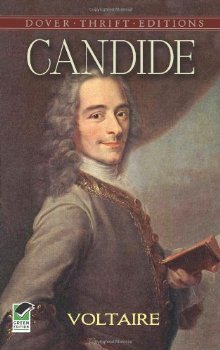
O - One Book You Have Read Multiple Times Again, besides Dr. Seuss? That would be Candide. Voltaire forever!

P - Preferred Place to Read 
Anywhere quiet.
A steady hum of sounds is OK. Jabbering, cell phone conversations, sitcoms, etc.? Not.

Q - Quote That Inspires You or Gives You All of the Feels From a Book You Have ReadObviously, Candide: "That is very well said, but we must cultivate our garden."

R - Reading RegretOther than maybe Cynthia Ozick, nothing I've actually read, but more all the time I've wasted not reading in this life.

S - Series You Started But Need to FinishSome people would say Harry Potter (I've read the first half of the first book...twice...)  Definitely not Sue Grafton's Kinsey Millhone ABCs, as I am So done with  all that. Let's see, what could it be? I haven't started Game of Thrones, really, though I did read the first few pages of the first, and that's my next-up series, I believe...I can't really think of any. Wait, Alafair Burke's Samantha Kincaid and Ellie Hatcher books are series, right? But she's still writing, and this is supposed to be a complete series. Ugh. Can I use Proust here, too?  Well, wait, actually, I think Alafair Burke is done writing Samantha Kincaid, she said, now that she's in New York. And I've read two of the Portland-set Kincaid series and need to read the third. So, that.

T - Three of Your All-Time Favorite Books(You see where I've already mentioned Candide and War and Peace multiple times, right?)
How about:
Lonesome Dove by Larry McMurtry
Pilgrim at Tinker Creek by Annie Dillard
Man's Search for Meaning by Viktor Frankl

U - Unapologetic Fangirl For...
Um.
Fangirl? Me? Ummm...
Anna Quindlen?

V - Very Excited for This Release More Than Any Other
 
Would it just be wrong to say my own book?
I'm so not the release-anticipating type with books. I've fallen behind on all my still-writing living authors (Atwood, Berg, DeMille, et. al.) I've got one word for you, kid: classics.

W - Worst Book Habit
Sitting here with a laptop on my lap instead of picking up a book?
Judging people who read trash?  (I mean real trash, like Twilight; I'm not disparaging the genres here.)
Disparaging genre fiction?
Forgetting what I've read?

You tell me; which is the worst?

X - X Marks the Spot: Pick the 27th Book on Your Bookshelf (from the upper left)
Dashiell Hammett, The Maltese Falcon

Y - Your Latest Book Purchase
Pretty sure it was at Schuler over Christmas when I picked up Night Train by Martin Amis and Game of Thrones by the inimitable conscientious objector George R.R. Martin. Have I bought anything since then? I don't think so. I tried to get Vanity Fair at our neighborhood bookstore in Lincoln Square, The Book Cellar, but couldn't find it, and at Women & Children First, I tried to get our next book group book, Eichmann in Jerusalem,  and they were sold out of that! So, back to the library...

Z - ZZZ Snatcher: Book That Kept You Up Way Too LateThis has not happened in SO long. I am a champion of falling asleep these days. I love getting sleep. I can't remember staying up reading, sucked in, since I was in Andong (Korea, in 2011)...either Freedom by Jonathan Franzen or Long Gone by Alafair Burke; I remember being up late reading both of those that year.

What a fun survey!

How about you?


Thursday, January 01, 2015

The Best and Worst I Read in 2014

I read 72 books in 2014! Well, OK, I read sixty-something books and I listened to a handful as audio books on my mp3 player while out walking or running. But for the purposes of this blog entry, same thing. Let's take a look at my 2014 year of reading in review!

I read more truly great non-fiction than truly great fiction this year. While I enjoy reading non-fiction and obviously love when it's great, I would also really like to be able to read more great novels, too, and by that I mean, I would like to stop being so disappointed in more than half of the novels I pick up. But we'll get to that in a second. First...

THE GOOD:
Easily the two best novels I read this year were Almanac of the Dead by Leslie Marmon Silko and Time's Arrow by Martin Amis. Both deal with the utter horror show that is humanity but in completely and totally different ways. The former is a gargantuan tome of Native American-Mexican-Arizonan-bring-on-the-revolution wisdom that will shock, horrify, and awe you if you have any ethical bones in your body. It will also teach you some history, make you homesick for Arizona if you're from there, cause you to seriously ponder your role in society and humans' role on the American continent and the globe, and possibly inspire a little tiny eensy bit of hope for the world. (But not too much.) There's also a fair amount of sex and drugs mixed in. It's hard to explain. The latter is Amis' famous novel told in reverse about a Holocaust "doctor" -- in order to grapple with the how-could-this-happen and how-did-he/they/we-become-evil questions, he tells the story backwards and it's basically genius.  I cannot recommend these two books highly enough.

The other good novel I read this year was Men Against the Sea by Charles Bernard Nordhoff, the second in the Bounty Trilogy. Actually, the first, Mutiny on the Bounty, was all right, too, but the struggle of the men in the boat in the second book is just so hardcore, and you end with so much respect for them and an understanding of their deep love for the boat that helped them and brought them to safety.

The great non-fiction I read this year includes:
Bury My Heart at Wounded Knee by Dee Brown -- This history of what happened to Indians in the American West should be required reading for everyone. The Shadow of Blooming Grove: Warren G. Harding in His Times by Francis Russell -- Yes, you actually do need to read a biography of Warren G. Harding, if for nothing else than for the shenanigans of the smoke-filled rooms at the 1920 Republican convention and for his kindness to puppies.
The Walrus and the Elephants: John Lennon's Years of Revolution by James A Mitchell -- I was born too late (to live in the early '70s) but John Lennon wasn't and he was incredible and I previously had no idea how hard the U.S. government tried to get rid of them. (And succeeded?)To Save Everything, Click Here: The Folly of Technological Solutionism by Evgeny Morozov --  If you hate when people say "X changed my life" or when people are hailed as brilliant because they gave a TED Talk even though they are physically incapable of critical thinking, you'll dig Evgeny's thesis. If you are bristling at these notions, you are in need of Evgeny's thesis.Zola and His Time: The History of his Martial Career in Letters by Matthew Josephson -- When I finally got around to reading a Zola book (Therese Raquin) the other year, I was less than impressed. But! This bio re-fascinated me about him. And poor, poor Dreyfus (he of the Affair) -- such a fascinating bit of history and a groovy group of literary pals, who are definitely not without their flaws. 
THE BAD: 
Get out of my face, Gone Girl, The Interestings, Sue Grafton, Sharon Olds (Stag's Leap and her undeserved Pulitzer in particular) and, frankly, Sophie's Choice, too. So much disappointment!
THE UNDERWHELMING: 
The Fault in Our Stars, The Amazing Adventures of Kavalier and Clay, Little Women (re-visited as an adult), No Ordinary Time, and some of Truman Capote's short stories included in the volume along with Breakfast at Tiffany's.  SOME FUN SURPRISES: The Wicked Pavilion  by Dawn Powell. Who knew?
The Moonstone by Wilkie Collins. Check it out if you want a classic novel that's also basically a pioneering mystery novel and not on everyone's radar.
Missing Justice by Alafair Burke. Even though I've read a few of her novels previously and I am well acquainted with her and her life commentary, I was still delighted by the sharp feminism in this page-turner.
Also, 10 A ños con Mafalda, a collection of the Argentine comic strip Mafalda, opened my eyes to a bit of social history I never would have otherwise known. 
And you? How was your 2014 reading?

Sunday, November 30, 2014

Project Finally: The Amazing Adventures of Kavalier and Clay

now finished: The Amazing Adventures of Kavalier & Clay by Michael Chabon

Um. Well. Comic books. Golems. Books I started more than a decade ago and got a hundred pages into and never finished and took this long to get around to re-reading...it's all here, folks!

This was for sure going to be a two-star rating until the last 60 pages or so. You redeemed yourself a little, Chabon, but barely. Escapistry, indeed! By the way, the three stars should not be construed in any way to mean that I suddenly liked the characters at the end of the book, because the big three are still pretty dismal attempts at How to Treat Each Other Well, but the ending was just better than the rest of the book, is all I'm saying. Weirdly, it was set on Long Island while most of the rest of the book is in The City (that would be New York) (except that part in Antarctica! yeah, don't ask...) so you'd think that wouldn't be a selling point for me, but anyway...

Have I mentioned this book is about comic books? And that there's a golem? Basically my two least favorite things ever. I was really, really starting to love me some Michael Chabon back in the day (circa 2001) and Wonder Boys made my list of Greatest Novels Ever and I read The Mysteries of Pittsburgh and A Model World.. and I was just devouring it all and I worked on a production of the play Poor Super Man and was totally digging the profound secret identity/comic book superhero as growth metaphor and was so ready to just love! and adore! The Amazing Adventures of Kavalier and Clay. Then I started reading it.

Slow going. Got to around page 90 or 100. Never finished. Haven't read any other Chabon since then, either.

But, you know, what with this being a Pulitzer-winner and all, I knew I was going to read it eventually, and I meant to and meant to and meant to and now I have FINALLY done it and my entire experience while reading it, before those last 60 pages, was that it drags and drags and that everyone in it does some stupid stuff and that the woman's feelings don't much seem to matter, and a few other spoilery things that aren't even worth going into because who cares?!

I actually think the whole overarching metaphor works; I don't think Chabon was reaching or trying to be too grandiose or whatever in conceiving this -- although that Antarctica part could maybe try to make a bit more sense -- but I just think the straight-up page-to-page writing was borderline snoozy a lot of the time. Especially during the flashbacky tales of escape.

I'm sure there are people who don't love comic books who were nonetheless able to love this book. I am not one of them.

But, wheee! I finished another Pulitzer book! Always a fun day.

Tuesday, October 14, 2014

If you can't hold on, hold on

finished: Time's Arrow by Martin Amis

Because the Holocaust doesn't make sense, how to make sense of the Holocaust? 

How can you write about it? How can you write a novel about it? Lots of people have, of course. How do you approach it?  You can't make sense of it. Can you try? 

Martin Amis has taken some flak for writing Time's Arrow. Some of it was how-dare-you-write-about-the-Holocaust-you-weren't-there. I'm not sure I find that point very convincing. Some of it was your-telling-of-the-story-backwards-is-just-a-gimmick. Some of it was you're-the-same-old-Martin-Amis-as-in-your-other-novels-and-I-like-to-bash-you. On the other hand, some reviewers apparently fell all over themselves to praise it when it came out in the early 1990s, what with its heavy, important subject matter, and Amis' important self. (Word order chosen carefully there.) 

I came later to the Martin Amis party. I'm pretty sure I'd never heard of him when I was in high school. I had heard of his pops, Kingsley Amis, by the time I finished college, but it was working in a bookstore that really put Martin on my radar. I got around to reading him for the first time in 2007, when I commenced my A-to-Z project, in which I read and blogged about a book by 26 new-to-me authors, one for each letter of the alphabet. I started with him, for 'A'--I read The Information and loved it. A couple years later, after making my way through the alphabet (hey, I was in law school--and besides, I always have lots of other stuff to read; it's never just one project at a time), I decided to select the Top Half and read another thirteen books by each of those authors. Amis made the cut. I then read Money. And, as time has marched on, I've continued by selecting six of those thirteen and reading a third book by each of them. Yes, Amis is in this select group of A-to-Z project semi-finalists, along with Truman Capote, Umberto Eco, E.M. Forster, Salman Rushdie, and William Styron. And this time around, my Amis selection was Time's Arrow.

Interestingly, this summer as I read third books by the likes of Capote and Styron and Amis, I was also preparing for my Habitat trip to Poland (which you can read more about here and here and here on my front page blog). And interestingly, it just so happened that I had months earlier, when I didn't yet know I'd even be going to Poland this year, acquired Time's Arrow for my Amis selection (at our favorite bookstore in Seoul, during our January layover) and decided to finally read Sophie's Choice for my Styron #3 (a decision made whilst we were still living in China). So there I was, in Michigan this summer, reading Sophie's Choice and also preparing to go to Poland. Naturally, I sought out some Polish literature by Polish writers at the library (all hail the GRPL!) and read stuff about the history of the country, too. But I also, in yet another twist of fate, happened to find myself this summer on Franklin Roosevelt in my read-a-bio-of-every-president project. It all came together. And what with Time's Arrow being a light, thin quality paperback, I brought it with me to Poland. 

There, I visited Auschwitz. 

I haven't yet shared with the world all my Auschwitz-visiting thoughts, of which there are many. It was such a mind-altering experience, being there. Here, let me just say this: I was so glad, when I read Time's Arrow the next week, that I had visited Auschwitz before reading it. 

To be honest, I wasn't all that fond of Sophie's Choice. I've seen the movie, years ago, so I knew all about the choice and the things that happen. And it seemed crazy that I didn't like it, because I have been so enthralled with my boy Styron up to this point, reading his earlier (more obscure?) stuff, like Lie Down in Darkness (my favorite book of the original A-to-Z 26) and Set This House on Fire (such a book for self-indulgent expat writers who think they have something to say to the world...)  But I thought that, frankly, Sophie's Choice totally failed. Styron's approach (gimmick?) was to narrate as a writer telling the story of Sophie, his friend whom he meets after the war, living in Brooklyn. Then she/the narrator recount her experiences in flashbacks, but they're all over the place, and the sexual overtones of it all are kind of abhorrent, frankly. Sophie desperately needed/needs to be rescued, but instead she continues to be taken advantage of and ravaged, by life and everyone. And everyone is a mess. Sure, these cynical things approach a truth about humanity, too, but they didn't really tell me the Holocaust/Auschwitz story it seemed Styron was trying to tell. 

Amis' approach was to get inside the mind of a former Holocaust doctor -- and I do mean, as a separate entity, who has somehow appeared inside the man's mind -- and go backwards from there. I thought Time's Arrow was incredible, and I admire it and Amis because he succeeds at demonstrating something for us. It's easy enough to say that only in a crazy, mixed-up world where time flows backwards could the Holocaust make any sense, but its another thing to write the novel that shows that. As we travel backward through time and through the life of Dr. Tod Friendly (and his several other later/earlier names), we know what's coming, and we read about him and his fellow Nazis "creating" a race of people out of fire and ashes. We all say that the death camp Auschwitz goes against all that humanity is. You certainly feel that during the portion of your tour when you step into the chamber that was once used to gas prisoners in the hopes of exterminating the Jewish people (along with hundreds of thousands of others). You can feel that again when you read Time's Arrow

When the backwards-running narrative finally arrives at Birkenau, you remember walking along that Birkenau train track, looking up at where it dead ends at the edge of the forest. Shit, you think. This world needs to be grappled with. You think that when reading, and when visiting. 

The story is basically too much to tell (not that we shouldn't try), and the "gimmick" of telling it backward turns out to be less gimmick and more way-to-access-this-thing. 

I read a biography of Martin Amis this summer, too. It was a light, I-think-just-this-side-of-unauthorized account, but it was interesting. Basically, I am jealous of Martin and his literary friends (Rushdie, Hitchens, Barnes, and the like, all those England Observer-writing literary intellectuals who get to just hang out being readers and discoursers together and writers when they are alone all the time) and I want to inhabit such a world (but hold the incessant womanizing, eh?) I read with interest about the friendships developed with Saul Bellow and the occasional arguments over Israel/Palestine politics. I must say that in a way, Israel/Palestine politics have nothing to do with the Holocaust. To equate critical analysis of Israel policy (or U.S. policy) with anti-Semitism and therefore "forgetting" (as opposed to, you know, never forgetting) is I think as insulting as what it's trying to insult. How can you make a political military issue out of this total affront to humanity? 

My incredible tour guide at Auschwitz said that the longer she works there, the less she judges people/countries/leaders, such as the Allies who opted not to bomb the railways leading to Auschwitz, and the more she remains neutral as she learns and is glad she wasn't in the difficult position of making those decisions. This is a woman who routinely communicates with Auschwitz survivors, and she shared some of their thoughts with us. She was steady, somber, and very informative. We walked around on a gray, drizzly day, through the mud and dirt, through the exhibitions, around the remains. Nothing makes sense. She explained it all to us, and the facts and exhibits and piles of eyeglasses and shoes make no human sense. But there they are. 

It's not about reserving judgment, or not taking a stand, or not believing in what's right. Backwards, we can approach this event with all the knowledge and all the judgment and all the pain, and see what we can see. We (humanity) obviously didn't see the Nazis when we went in chronological order, so Martin helps us by approaching them the other way. 


Thursday, April 10, 2014

Potpourri of February/March Reads

Some recent reads, in rough order of worthiness from best to worst:

These were good and/or great
The Moonstone by Wilkie Collins
August: Osage County by Tracy Letts
Lonely Planet's Phuket Encounter

These were meh/suspect
The Crazed by Ha Jin
Coolidge by Amity Shlaes


This one should be thrown across the room
Gone Girl by Gillian Flynn

Yes, that's correct. Gone Girl is in dead last on the list. I'll get to that in a second. Oh wait, maybe I should say "I'll get to that in literally one second." Which is not true, because it's going to be more than one second, and the expression "I'll get to that in a second" is FIGURATIVE, but apparently the authors and editors in the publishing industry today (see also: The Hunger Games) don't actually have to know what "literally" means but they can use it over and over and over (literally dozens of times!) in these contemporary please-take-me-seriously novels, jarring the reader (but not literally jarring, because how could an author put me in a jar?) and making it so obvious it's the author's voice coming through. Not the literary voice or the writing voice, but the text message voice. That doesn't really work when you tell a story from the points of view of two different characters, but they both just sound like you replying to an email.

Contrast that with The Moonstone, a gem (see what I did there?) from Victorian England, but not your English teacher's Victorian England novel. It has been called "the first detective novel" (would Agatha Christie and the author of The Invention of Murder agree?) but what's so great about it is the narration. There are a few point of view shifts, and each character's distinct attributes are fun, but the snark of the old servant who tells the first half is an unbeatable delight. I love reading classics for numerous reasons, but the fact that they are better edited than most of the crap on front-of-bookstore tables is starting to become a main one. It's bad enough that we live in a memoir- and blog- and print-on-demand-glutted world where everyone who thinks they write can "publish" their words, but when the actual publishers allow sloppy, comma-spliced "voices" to infiltrate the bookstore shelves, it's the beginning of our decline and fall. And that doesn't mean reading can't be fun. I have found most mystery/thriller page turners to be generally well edited over the years, but I guess that is changing. If you want to read a classic that doesn't feel like slogging through a classic, hie thee to The Moonstone.

I read The Moonstone in Phuket, mostly while lazing by the pool and/or by the sea, and while we were there I also read Lonely Planet's Phuket Encounter. Obviously, I had skimmed that before (on our first trip to Phuket) and used it as a reference, but this time I read the whole thing. It just so happens that we also seriously considered moving to Phuket while we were there (I had a job offer, but didn't take it) and I was  enjoying thinking about getting to know the place more deeply as a resident, but still really enjoying it as a traveler, and the Encounter books are good for that: an enriching taste of a place, with where-to-go and what-to-do ideas plus tidbits and a real feel for the spot and its vibes.

I also sat in one of my favorite Phuket coffee shops and finally read Tracy Letts' play August: Osage County. I can't believe I haven't seen a stage production of it (yet) as it has been on my radar since I lived in New York, but it's gloriously funny and dark and I think it's wonderful. I love the wicked dysfunction when it is done so right. Once we returned to Phoenix, we saw the film, and I think Julia Roberts was robbed of a Supporting Actress Oscar.

On to the incredibly average! Our friends whom we met while teaching in Korea and who now live and teach in Shanghai came to Thailand while we were there so we could all hang out in our third country together, and one of them passed along to me Ha Jin's The Crazed, partly because she gave up on it out of boredom. She had heard quite a bit about it, which makes sense since it's about university grad students and professors in the north of China, kind of the exact life my friend is currently living only without the whole lead-up to Tiananmen Square uprising factor. I've still never got around to Waiting despite the many times I touched it at Borders, so this was my first Ha Jin. The story wasn't terrible -- the main character's emotional meandering was a little weird, as was his inability to focus, but it didn't really devolve into unbelievability until the end-- but the writing itself is, for me, filed under "What's all the fuss about?" The main thing about it is that it feels like reading a translation of Chinese language, even though Ha Jin writes in English. This tells you SO MUCH about language, and it is so interesting (for someone like me, who likes words and language) to contemplate the differences between what-we-call-Mandarin and English, and it opens up fascinating questions about translation of literature, our own personal translations of our inner voices, the neuro-linguistic processes of creating art, and so on -- but I really wanted a novel and not a case study. I don't see how people can fawn all over his writing if it all comes across like this, because it doesn't feel natural or like a native speaker at all. Should published writing have to feel like it was written by a native speaker of that language? Which is worse, that Ha Jin sense of prose detachement and not-quite-being-there in the language, or the Gillian Flynn feeling that someone is "literally breathlessly talking to my best friend!!!" as they jabber in a purposely casually unpolished first person?

Coolidge was "meh" for entirely different reasons. Amity Shlaes apparently has writing skills and editors, but her structural and philosophical problems outweigh mere questions of storytelling quality. It's exciting to move into the modern presidents in my Prez Bios project, but I didn't know Shlaes was going to usher us in with this In-Defense-of-Reaganomics screed. She is so eager to prove that if we had listened to Calvin Coolidge's thrifty New England budgeting advice (not that silent Cal was discoursing to many people) we wouldn't have ruined our nation/economy/lives that she makes great leaps in both logic and paragraph construction.

Her book feels like this: "So, Calvin and Grace, now a settled married couple on the political rise, gazed with wonderment at the Boston politics Calvin was dipping his carefully scrubbed toe into, and they set up their Northampton kitchen and ordered new drapes that Calvin cleverly found in a catalog sent from his Amherst classmate who now runs a railroad car and why can't you people see that Wilson ruined everything by allowing Democrats to hang things in the White House windows!?! Those Democrats were signalling to all the world our fear, hiding from the economic truths of cost-cutting and good, solid American materials.  Also, you should pray at night before bed. Let's skip now to Calvin becoming vice-president. Oh wait, you mean I'm actually supposed to connect his life's timeline together in this biography? I'd rather show how his son dying clearly reflects the impending doom of our nation, with Franklin Roosevelt lurking somewhere on the White House lawn, poisoning the Coolidge boy himself. Or was that just a fever dream I had?"

In other words, I learned a lot, including how to read a biography/political interpretation skeptically, a lesson Shlaes teaches rather well.

Last, and very certainly least, we have Gone Girl, the book that took bestseller lists by storm. As one of my clearly brilliant Goodreads friends put it, "It is a book for non-readers who 'read' and like to recommend the book they are 'reading.'" The first half is engaging, if not engrossing, although it's only eighty or so pages before the intern who was in charge of removing "literally" from every other page apparently had to go back to class or checking Instagram or something. Frankly, I related a ton to "Diary Amy," which as I'm sure your book group pointed out gives us so much to ponder about relationships, psychology, how well we know people, blah blah blah. That's all well and good, but then the book starts to veer way off course with its (ideologically) flipped-about second half, and seriously, the less said about the ending, the better. Not because I can't say anything more without majorly spoilering (which is true) but because it's so awful and so doesn't quite work, despite how well Flynn thinks she has stacked the deck against one of her characters (get out! get out! get out! yes, you can get out! and by the way, you suck, too!) .... This book is just a big sigh. Also, a deeply troubling symbol of the state of the U.S. publishing industry: Hold me, thrill me, kiss me, kill me, but don't waste time with silly things like editing, syntax, and vocabulary; what do you think we are, writers or something?

Ugh. I literally wanted to throw the book across the room when I literally  finished reading it, but I was literally reading it on a beach, so I literally had to drop it on the sand instead.

True or false: The word "literally" is used correctly in the previous sentence.

(I wouldn't suggest checking your answer with Gillian Flynn.)

Sunday, January 26, 2014

A literary realist, a philosopher, and a crime novelist (walk into a bar?)
Or, 2014: So Far

now reading: The Shadow of Blooming Grove: Warren G. Harding in His Times by Francis Russell

Yes, yes, we're back. 2014 is going to be a year full of reading projects. No, this blog was not updated at any point in the latter half of 2013, a fact I most regret. But let's not dwell on the spilt milk, am I right? Let's pour ourselves a fresh glass - soy, if you please - and get cracking on all the books that are fit to read for 2014, which stretches so nicely ahead of us.

2014 reads so far

The trio with which I've opened the year are three oh-so-very different books.

The Beast in the Jungle by Henry James
I've gone on a bit of a Henry James tear of late, not for any real reason other than that I had a collection of his novellas sitting around. I believe I got this packed-to-the-gills edition while I was at USC, but I also believe that I blew off some of my Henry James reading back in the American Lit major day, because I don't recall a thing.  Or is he just that unmemorable? The latter may be all too true. After mildly enjoying a few of the novellas/short stories (espcially "The Aspern Papers") (but that really is a short story, wouldn't you say? I think only Beast and The Turn of the Screw seem long enough to be novellas) I read this Beast last and thought it the most overrated of all. I've been hearing all my life about the homosexual subtext of this thought-provoking masterpiece and I've gotta say, I just didn't see it (neither the homosexuality, nor the provoked thoughts, nor the masterpiece). What on Earth happened between Archer (was that his name? I've already forgotten) and May Bartram?  Oh wait, Marcher. I knew Archer didn't sound right. Well anyway, what was that all about? These two might have the weirdest unconsummated relationship in all of literature, or maybe the weirdest of any relationship. Apparently Mr. James was trying to grapple with/tell us about fate and loneliness. So he has this guy who's convinced something big is going to happen to him and blah blah blah, but how does he get HER to join in with him waiting for this stupid fate? Why can't she wait for her own fate? This book blows me away by how unrealistic it is. Who lives like this? Literary realism, my foot. Anyway, it's over quickly enough, at least.

The Philosophy of Aristotle
Meanwhile, my philosophers project still hasn't really got off the ground, so I've decided to reframe it. I was going to read one philosopher per month each month of 2013, but instead all I did was read a bit about Thales online, then read The Dialogues of Plato (for Socrates) and Republic (for Plato) and then, wouldja look at that, 2013 was over. SO: we'll just say that doing the ancient Greeks was priming the pump, and now that I've done those guys AND Aristotle -- whom, surprise, surprise, I relate to the most (minus the misogyny) -- I will jump into a year of reading 12 philosophers, one per month, as soon as I'm ready to commence that project, which I think will be later this summer. (Because: so many other reading projects to get caught up with in the meantime.) I have to say that reading some of ol' Aristotle's Metaphysics and Logic can be tedious, but Poetics cheered me right up. And really, the guy was a genius. Except for the whole slavery and sexism, ugh, WHY?

212 by Alafair Burke
Aaaaand, a mystery. Mostly because I didn't read my yearly Alafair Burke in 2013 (I didn't set out to make it a yearly tradition, but the last three years living abroad in three different places, I've acquired three of her books on my Kindle for PC (because I have YET to see her paperbacks on sale in any bookstores in Asia; what gives?) and happened to electronically read one in each ESL-teaching-abroad apartment...and though I didn't get to one in China in 2013, everybody knows that even though it was January 2014 it wasn't the new Chinese year yet, so I was still safe. 212 is the third in her Ellie Hatcher series, the spunky Manhattan detective, and there's actually a fourth already out that I will get around to in some future summer. 212 came out a few years ago, I think while I was living in Chicago. As always, reading her books makes me miss living in New York City. This one was all right: interesting banter, really interesting characters (who make terrible choices) (yes, I am judging what some gals choose to do with their lives), and lots of different things going on.  However  SPOILER ALERT!!!   *spoiler spoiler go on to the next paragraph if you don't want a spoiler*  I think that what's-his-name the former cop should have been given more to do --perhaps more banter!--because he was kind of lurking in the background but he was so pivotal, helpful, and involved with different characters in different ways that it made it kind of obvious that he was the bad guy. However to my however, that didn't actually ruin the reading or anything because you still don't quite know how it all fit together. STILL SPOILERING HERE !!!! I also wasn't sure how I felt about the #ambiguousI'mnotambiguous climactic shooting. It was definitely "kind of shady, morality-wise," as Skinny Pete (or was it Badger?) would say. And finally, throughout the novel there are some paragraphs that pop up in which somebody talks too long, uninterrupted.  I often think about this myself, when writing dialogue.  You don't actually write dialogue exactly as people talk, obviously, but you can't cross the line into the place where it's JUST an explanation/rant/showing off of wisdom and no longer resembles real conversation flow. (Are you listening, William Styron in Set This House on Fire?) It might sound like I'm criticizing the book, but I actually just compared Alafair Burke to the great and mighty Styron, so there's that.

Is it interesting that I warned you away from the above paragraph if you don't want spoilers but feel under no obligation to do so, on this blog at least, for Henry James?  Hmmmm.

And now, you ask? Why, I'm reading a prez bio of course.  Stay tuned; in my next post we'll check in with the status of my bio-of-every-prez-to-see-where-we-went-wrong(a project obviously conceived and named during the Dubya "administration").


Sunday, October 07, 2012

When Yalom Babbled

finished Sept. 4th: When Nietzsche Wept by Irvin Yalom

Apparently, this book has a subtitle. The whole thing is When Nietzsche Wept: A Novel of Obsession. Well, as I noted on Goodreads when I first finished it, it didn't strike me as a novel of obsession at all, more like a novel of jabber.

I mean, with a title like When Nietzsche Wept I would expect it to be most if not all of the following: dark, literary, intellectual, profound, edgy, dense.  This book has been on my bookstore radar for years, bought by lots of those black-clad young professionals and artists and dark-side-of-preppy university students. I had high hopes. But, Yalom's novels just really aren't like that at all. They're downright lighthearted.

In fact, as I read When Nietzsche Wept, I began questioning myself as to why Yalom even made it to the top half 13 authors of my A-to-Z literary blog project.  The first book I read of his, when I originally chose him as my 'Y' author, was The Schopnhauer Cure, and it was like this in a lot of ways:  oddly frivolous,  pretty contrived, and in many ways not really a novel at all, but forced into the format of one.

Anyway, it's interesting to learn about Nietzsche and the psychologist Dr. Joseph Breuer whom Nietzsche apparently never met but whom Yalom imagines him meeting for this novel. But then, as with all historical fiction, I find myself wondering how much of the imaginings are just distortions that would never have happened but exist only in the author's mind but are now going to be forever associated in MY mind with these real historical figures (and this is why I hate historical fiction, duh.)

But if this book hadn't skipped along quickly like the trifle it is, it would have annoyed me. I am definitely not passing Yalom on to the semi-finals. His books remind me how interesting these philosophers are -- I mean, I totally get his love for/admiration of/desire to write about cool people in Western Philosophy -- but mostly they just make me want to put down his novel and go read the philosophers' actual words, myself.

Tuesday, September 18, 2012

Awesome Quotes From Shalimar the Clown

finished a while ago, and loved: Shalimar the Clown by Salman Rushdie

I didn't even mean to read Shalimar the Clown, as I have mentioned, but it turned out to be wonderful and magical and awesome. My boy Salman Rushdie is such a writer, and he weaves and spins the language and characters into far-flung locales that feel close to home, serious whimsy, and really personal tales that resonate globally. This book, even more than The Satanic Verses, made me just LOVE how Rushdie's brain works. I will offer up a few sample quotes from the book, to try to convince you of its perfect truth:

"Religion was folly and yet its stories moved her and this was confusing." ( p. 22) 

"Again with the religious imagery. New images urgently needed to be made. Images for a godless world." (p.23)

"He tried to believe that the global structures he had helped to build, the pathways of influence, money and power, the multinational associations, the treaty organizations, the frameworks of cooperation and law whose purpose had been to deal with a hot war turned cold, would still function in the future that lay beyond what he could foresee. She saw in him a desperate need to believe that the ending of his age would be happy, and that the new world which would come after would be better than the one that would die with him." (p.24)

"They don't make no glass slippers no more. They already closed the factory." (p. 46)
(and everything else that comes out of the mouth of the Russian landlady who says this)

"The Ass, by contrast, is a coward and runs from danger; however you must remember in mitigation that he is an Ass, just as a jackal is a jackal and a leopard is a leopard and a boar has no option but  to be boarish one hundred percent of the time. They neither know nor shape their own nature;  rather, their nature knows and shapes them. There are no surprises in the animal kingdom. Only Man's character is suspect and shifting. Only Man, knowing good, can do evil. Only Man wears masks. Only Man is a disappointment to himself." (p.113-114)

An entire passage making fun of military-government "reasoning" about dissenting citizens: the integer/fraction/integrity/India/Kashmir bit on p. 119.

"'You can know a man for fifty years,' he said, 'and still not know what he's capable of.' Harbans shrugged in self-deprecation. 'You never know the answer to the questions of life until you're asked,' he said." (p.354)

"General Kachhwaha despised the fundamentalists, the jihadis, the Hizb, but he despised the secular nationalists more. What sort of God was secular nationalism? People would not die for that for very long." (p.373)

"He named the Los Angeles River after the angels of Assisi and their holy mistress and twelve years later, when a new settlement was established here, it took its title from the river's full name, becoming El Pueblo de Nuestra Señora la Reina de los Angeles de Porciúncula, the Town of Our Lady the Queen of the Angels of the Very Small Plot of Land. But the City of Angels now stood on a Very Large Plot of Land Indeed, thought India Ophuls, and those who dwelt there needed mightier protectors than they had been given, A-list, A-team angels, angels familiar with the violence and disorder of giant cities, butt-kicking Angeleno angels, not the small-time, underpowered, effeminate, hello-birds-hello-sky, love-and-peace, sissy-Assisi kind." (p.416)  
Note: This last one may be my favorite L.A. quote of all time. Definitely up there, anyway.

This is a sample of what you have in store when you read Shalimar the Clown.  So much wonderful!

quotes taken from mass market edition ISBN: 0-8129-7698-3

Monday, September 17, 2012

Highly recommended alert: Shalimar!

now finished: Shalimar the Clown by Salman Rushdie

I hadn't really planned to read Shalimar the Clown. Careful readers of this blog(and even some of the half-assed ones) will recall that Salman Rushdie was my 'R' author in my A-to-Z Literary Blog project, wherein I read a book from each of 26 new-to-me-but-famous-and-I-always-meant-to-read-them authors, one for each letter of the alphabet. (Mostly. Sorry, Gao.) For my first Rushdie, a few years back during the project, I read The Satanic Verses. (Um, it was weird. Good, but weird. And anyone who wants to kill an author for writing a book is a stupid worthless stupid dumb jerkity jerk, end of story, but no, I did not see anything in that book worth getting outraged about.)  Now, I am deep into my A-to-Z Top Half project, wherein I chose my 13 favorite authors of the 26 and am reading a second book by each of them. I have only a few left! So, here I am in Mexico, with less access to the books in English than I normally would have, so I asked some of my fellow expat reading peeps around these parts if they had any Salman Rushdie, because that's a pretty likely thing among travelers/English teachers, unlike some of my other A-to-Z top half authors (I'm looking at you, Warren-Styron.) I pretty much just assumed someone would have Midnight's Children, but instead, I was loaned Shalimar the Clown.

Well, guess what? It's awesome. I mean, seriously awesome. Its awesomenes sneaks up on you, too, so you're going along about page 350, 360 or so, and you've been caught up in these characters for a while, and you've learned a lot, and you REALLY want to go visit Kashmir because it just sounds heavenly, and you really like what he did with his descriptions of L.A. in the first chapter, and you totally dig lots of the characters who live in these two villages, and you are starting to think about big global issues because you see how its all coming together, and - wow! It hits you. This is going to a really awesome place, isn't it?

Of course, it's horrible, what happens. Because revenge is horrible, but specifically, death as revenge is horrible. And no, I am not spoiler-ing, because said murder happens in the first chapter, but then you learn more about it for the rest of the book. And you learn about a million other things besides. Among them: on what grounds would you, yourself, kill. To save your own life? Your family's? Your country's?  What about to save those entities' honor? Ahhhh, the lines we draw.

Salman Rushdie is, of course, awesomely equipped to write about this subject, being the object of the horrible stupid horrible nonsensical violent murderous horrible fatwa and all. But he doesn't hit you over the head; like I said, the awesomeness of the big questions sneaks up on you.

As I mentioned in my Goodreads review, this book should be required reading for everyone in the post-9/11 world, but unfortunately, so many people just would not get it.

Monday, July 09, 2012

In which I eventually get to the point about Alafair Burke

now finished: Angel's Tip by Alafair Burke
now also reading because Angel's Tip was on my Kindle for PC and I need to have a real book with me: I'm a Stranger Here Myself: Notes on Returning to America After Twenty Years Away by Bill Bryson

Here's my recommendation for you: Alafair Burke. Now, please recommend a mystery author to me.

While it has been said that I refuse to read genre fiction, that is not actually true. I avoid genre fiction, which is quite different. However, of the genres, mystery is obviously the one that I'm most likely to read and/or enjoy, and I do so from time to time. My favorites, the ones who have inspired me to go out and devour their entire oeuvre, have been Sandra Scoppettone and Nelson DeMille. I have enjoyed mysteries from several other authors, too, but there are two main problems with reading mysteries:

1. Buying them when they are brand new really is cost-prohibitive for the amount you would want to read. What I mean is, they go by a lot faster than some "literary fiction" or non-fiction, so if you're going to go spend 30% off of $24.95 on a hardcover, really, which book is more worth it? The one that you'll still be reading in a few weeks, obviously, not the one you can finish on the bus ride home from the bookstore. This is why a.)libraries are awesome and b.)so are used bookstores and book swaps and c.)the Genres (mystery, romance, sci-fi, fantasy, horror) do so well in mass market - they're cheaper that way! This is also why I immediately bought Alafair Burke's 99-cent downloads for Kindle for PC when her publisher offered the limited-time sales, because that's an awesome way to buy mysteries.More should be done, I think, to make the suck-you-in-stay-up-reading genres cheaper when they are new, and then there would be more new book sales, at least to me.

2. It can be intimidating to choose a new mystery author, because unlike, say, my A-to-Z- Literary Blog Project, in which I chose a book from 26 different authors I had not previously read, one for each letter of the alphabet, and I did not feel particularly compelled to read their other books first or all at once (or, in the case of 'O,' any other books of hers at all, ever ever ever) but with a mystery you might be browsing in the bookstore and come across some mystery that looks quite good and you're about to go ahead and get it when you notice that it is "Sammy Sleuth #3" or whatever, and then you decide to start with #1, but the bookstore has the whole series in stock except the first one, and so you make mental note to look for the Sammy Sleuth series next time you are in a bookstore or library, but then the other 900 books on your to-read list get in the way, and life happens, and then you find yourself a decade after deciding to read Sue Grafton's A to Z Kinsey Millhone series (being clearly fond of A-to-Z things) still stuck on 'E'...or was it 'F'?...and really meaning to catch up but you couldn't just buy them all in one fell swoop. Or is that just me?  (But you still have big plans to catch up by the time Sue Grafton's Y comes out, and then you can anticipate and await and maybe even buy Z all brand new hardcover like. With a coupon.) (Although, recall that I have a major problem with people who make the letter X "stand for" something it doesn't stand for, like in a kids' book that doesn't want to do xylophone or x-ray again so it tries "X is for eX-treme" or whatever. No. Just, no. If Sue does that, I retract everything I've ever said in support of her A-to-Z series and I'll stop at K, or wherever I am when that happens.)

Oh yeah, and I also read a few more  mysteries when I worked for Borders and had a.)an employee discount b.)check-out privileges for those new hardcovers c.)advanced reader copies galore. That's when I read one each from Harlan Coben, Michael Connelly, James Lee Burke, and a few others...but even then I would feel, like, really really compelled to read, say, all of the Dave Robicheaux novels in a row, although of course I didn't, and then I felt guilty about that. Christ. This is the problem mysteries present to a devoted but kind of weird, obsessed-with-planning-things-out reader.

ANYWAY. Alafair Burke. (And why yes, they are related, but their books are totally different, so don't be all stupidly reviewing her on Goodreads by saying, "Two stars -- she is  nothing like her father" because that is just dumb. Drew Barrymore is not like Lionel Barrymore, but they entertain in different ways. What is wrong with people?)

So Angel's Tip is the fourth Alafair Burke book I have read, which is not bad! for me! -- although this is her New York-set Ellie Hatcher series and I did leave Samantha Kincaid hanging, note to self, must get back to those --but, see, I had this extra motivation of sort of knowing the author. Careful readers will recall that I first read Alafair Burke during law school because she was my Criminal Procedure professor and as usual during the law school semester I missed reading my book-books so terribly much and then I hit upon the idea that I could justify reading an Alafair Burke thriller as studying for her exam. This was not as much a stretch as you might imagine, because she does drop some procedure in there, thank you very much. 

I had no idea what an Angel's Tip is before reading this book. Turns out  it's a drink. A little too sweet and chocolate-y for my tastes, I think. Reading this book made me super-duper nostalgic for living in New York, and although normally when I contemplate moving back to the U.S. and "settling" somewhere I usually dismiss New York as too a.)expensive b.)full of New Yorkers (specifically, those who say New York is the greatest place in the world without having lived in the rest of the world), this week I just was all like, "Oh, Manhattan! I sure did like living in Brooklyn and being in the city all the time and riding the subway and seeing historical things and the actual Macy's on 34th Street and McCarren Park and Chelsea Piers and Central Park and Roosevelt Island and lots of food and bars and sports and art and whatnot..."

One of my favorite things about Alafair Burke's books is when her characters say snarky things. Alafair likes the clever, incisive snark (to wit: she recognizes Entertainment Weekly as the genius magazine that it is) and she's rather good at snark herself, and I like it when her characters bust it out. She also weaves pop culture references throughout her novels. I have this vision of some literary archaeologist a hundred years from now reading her books and commenting on how they decidedly capture turn of the (21st) century New York, but who was this Zac Efron fellow?

One of my favorite things about this Alafair Burke book in particular is that it makes a little fun of the whole cluuub scene, particularly in the meatpacking district, where people are paying $400 for a bottle of liquor so they can get bottle service and feel special or rich or something. I do recall my minimal experiences with bottle service at the dance club (clearly, I was hosted by other peeps) and I don't think I will drop that kind of money on alcohol even when I have it one day. I have never been fond of standing in line to get into a club or bar, and I liked that this book revolved around that scene, which is fun to mock a little bit . I was also exceedingly happy to find in this book a petulant law student, a hideously unethical lawyer, and a philosophical conversation about whether one should go to law school.

I'm not going to say much more about the plot. I half believe that mysteries shouldn't even have anything on the back cover besides blurbs and an author bio. I don't want to know anything about a mystery before I start reading it. (This may be another slight problem in my whole finding-mysteries-to-read thing.)  But I will say that I do recommend Angel's Tip and it totally sucked me in. I was reading it on Kindle for PC, having downloaded it all cheaply, but I don't take my laptop everywhere so I had to go away from it a lot and I would be itching to get back to it and find out what happened next. Oh, and also?! I actually had a suspicion of whodunnit, and this absolutely never ever ever happens for me, so that is weird. Finally, I must tell you that I enjoyed Angel's Tip more than the first book in the Ellie Hatcher series (Dead Connection) but of course I can't recommend that you start with Ellie Hatcher #2, so... yeah. You'll just have to read them both. If you are capable of plunging in with #2 in the series, you are a better different reader than I!

And now that I have recommended Alafair Burke to you, bring it! Who is the mystery/thriller author that I should be reading? Remember, I love Sandra Scoppettone and Nelson DeMille, I enjoyed Tell No One as much as the next bookseller, I really dig the interviews I've read/heard with Sara Paretsky and Karin Slaughter although I've never got around to reading their stuff, and I freakin' hated Men Who Hate Women, or, as you know it, The Girl With the Dragon Tattoo.

Final Grade for Angel's Tip: B

Saturday, June 30, 2012

When in Mexico...
(or another Spanish-speaking/reading country)

now finished: El Paraíso en la otra esquina by Mario Vargas Llosa

So obviously I have had Mario Vargas Llosa on my to-read radar (to-readar?) for a while. He's all famous and literary and won the Nobel Prize and stuff, so eventually I would get around to him. But then we showed up in Querétaro and right away I found a book group and they were meeting, like, ten days after I arrived, but hey--why not? I headed to a little bookstore here in the Centro Histórico and picked up a copy of El Paraíso en la otra esquina (translated as The Way to Paradise, more on that in a sec) and plunged into my first Vargas Llosa -- en español! 

Now, I have read quite a few books in Spanish, but mostly young adult books.  I also occasionally read Spanish newspapers. This was kind of a jump in difficulty level, but actually, I could do it! I love reading in a foreign language and I have long since (we're talking decades) known that the way to go about it is not to keep a dictionary there and look up every single word you come across that isn't "Hola" or "agua" or "isla." Just like when you acquire language naturally as a child, you learn things from context and there are many times when at first I am not quite sure what a sentence says, but I read the entire paragraph and then go back and read the paragraph again and the second (or sometimes third) time through it dawns on me. It's as if you can actually feel your brain acquiring language. I love language. This is part of why I enjoy ESL teaching -- and writing, and reading -- language is magical. If humans contributed nothing else to this planet (and at times, this is a premise worth considering), then what we've done with languages is enough to fascinate the eternal universe, I say. 


OK, so back to Vargas Llosa. Famous, always meant to get around to reading him, now I have. They say (I know, who are "they"?) that he's "right-wing" now. I didn't see it in this novel; instead, what I saw was a really fun cynicism about lots of different people in society, with a bit about the seemingly futile struggle to free and liberate the oppressed and also a few sharp jabs at the very wealthy who feel oh-so-entitled to all that they have. 

And then there's Gauguin.
El Paraíso en la otra esquina tells the stories of two people, in alternating chapters: painter Paul Gauguin and his quest to find paradise and a return to the "natural" Eden-like state of humanity, notably in Tahiti, where he paints masterpieces but also "marries" several 14-year-old girls, and Flora Tristán, the grandmother of Gauguin, who travels in France, England, and Peru during the 1830s and 1840s trying to raise the consciousness of workers and to unite women and other oppressed classes in a struggle to be free. Also: she realizes that sex doesn't have to suck (as it did with her husband) when she has a wonderful affair with a woman. This book is very sexy, at times. Politics and art and sex. What more do you need? And as a bonus, there are religious hypocrites. Sometimes Flora gets into it with them: priests, rich bosses who exploit their workers, grande dames of society, and the like. "Dedicar nuestras vidas a ejercer la caridad," some rich women tell her, to which she replies, "No, ustedes no practican la caridad. Distribuyen limosnas, que es muy distinto." (-p.64 of ISBN 978-607-11-0763-3)

I think it's great. Gauguin is a jerk when it comes to the way he treats some people (for example: females) but he is a fascinating character, and that's what we ask for in a novel, no? Also, you can relate to him if you're an artist and traveler, so I was definitely hooked even though I knew his struggle to find paradise was doomed to be doomed. The title refers to a children's game that the real life Gauguin likely played in Peru where the kids ask for paradise and are directed to the other corner (does anyone know this game in real life? and I'm trying to figure out if there is a comparable game anyone I know in the U.S. played?) and for this reason it bothers me that the English title is translated as "The Way to Paradise." Although that captures, for the most part, the quests of Paul Gauguin and Flora
Tristán, it doesn't really capture the way the game is invoked, described, and revisited at the end of the book to come thematically full circle. Why can't titles just be translated literally?! I don't mean translated literally when the word-for-word translation does not evoke the idea, but I mean translated without creating a new meaning. (See also: my rant about Men Who Hate Women with Dragon Tattoos.)


This book also really made me want to go to Peru. I wanted to go there anyway, but this ratcheted it up a few notches.I think it was helpful for my Spanish for me to plunge into a book in Spanish during my first month in Mexico. I still need to read, speak, and write more in Spanish -- a lot  more -- but this was a good kick-start. And I will definitely be reading more Vargas Llosa in the future. The to-readar grows ever more crowded!
Final grade: A-  (Because I'm such a hard grader. It could be an A, maybe. I'll see how it compares to other Vargas Llosa books and then decide for sure.)

Sunday, May 27, 2012

Wait, like, that Cold Water Flat?

finished: Tinkers by Paul Harding
next up: Gentleman Boss: The Life of Chester Alan Arthur by Thomas C. Reeves

current audio listen: The Dead Hand: The Untold Story of the Cold War Arms Race and Its Dangerous Legacy by David E. Hoffman

From the "Who Knew?" files: Paul Harding, who wrote the Pulitzer Prize-winning Tinkers, is Paul Harding, who was in the 90s band Cold Water Flat.

OK, so I'm a bit late to the Tinkers party. But here's the thing: I was totally one of the few who were AT the Cold Water Flat party, so what do you have to say about that, huh?  It's true. When it comes to mid-1990s alterna-pop and non-top 40 radio, I am your girl. Better than Ezra? Jennifer Trynin? Grant Lee Buffalo? Sinead Lohan? Freedy Johnston? Bring it. Been there, done that, bought the CDs, because those were the days when you liked the single played on the radio so much that you went to Zia or (R.I.P.) Tower and bought the CD, not like now when you like the song played on the radio/Lastfm/Spotify/YouTube so much that you go to iTunes and buy the song. Which you already know and hear all the time. What's the fun in that?

Anyway, so Cold Water Flat is in fact one of the bands that is even a tiny bit more special for me because I was also at the Internet party in 1995 (when many of you -- don't deny it! -- were still a bit befuddled by all this talk of Telnet and chat rooms and the someone@something.com beginning to appear under the names of readers who wrote letters to the editor of Newsweek. So it was still somewhat of a novelty for me to e-mail Cold Water Flat at the e-mail address printed in their liner notes and talk about how I worked at my (ASU) college radio station and their upcoming show in Phoenix and so on ... and I got a response! I totally emailed with someone from Cold Water Flat back in the day! And no, I can't remember any of the details. Or even that long gone ASU e-mail address of mine. I transferred to USC the next year, and eventually the whole world got online, and the past faded away.

Fast forward to 2010. I'm in Chicago. I've got 700 books on my Goodreads "to-read" list. Tinkers by Paul Harding wins the Pulitzer for Fiction. No one has ever heard of this book. The interesting story in all the press and interviews and newspapers is how it was rejected by publishers before the tiny Bellevue Literary Press printed it in all its small but remarkable literary silence. The New York Times' "Look who wrote a Pulitzer" piece doesn't even mention that he was in a band until the fourth paragraph; the name Cold Water Flat comes in paragraph 14. I didn't read that New York Times piece in 2010. I noted the Pulitzer winners (because, um, I always do, since I kind of am obsessed with the Pulitzers) but all I remember thinking about Tinkers was, "Oh, that's really small. What is it? Oh, it's a tiny little white book. Note to self: read Tinkers."  The title and description evoked in my mind someone older than, you know, my approximate age or a few years older. The author was obviously literary, an Iowa Wrtiers' Workshop graduate, and I mentally placed him in his 50s. (Oh, hush, you know we all make random judgments like that.)

Fast forward again to May 2012. I'm catching up on recent Pulitzer winning fiction, and I check out Tinkers from the Phoenix public library. I read it in a day or two. I like it a lot. I start reading some of the post-Pulitzer  press, no longer afraid of spoilers, devouring the info about this literary wonder author who was checking the Pulitzer web site to see who won when he discovered that he won. And then I see: the drummer for Cold Water Flat. Such a flashback! Two of my worlds colliding!

I try to picture myself driving around Phoenix or L.A. in the late 1990s. I may have sold my Cold Water Flat CD in one of my great used CD purges -- back when you could actually get some money that way. Would I have ever imagined that one of the members of this band would write a novel that would surprise everyone by quietly becoming a Pulitzer Prize winner? Would the members of the band have imagined it, either?

I love creative people.

Oh, and guess what? Jen(nifer) Trynin has written a book, too. 


Saturday, May 26, 2012

The beauty of Tinkers

now finished: Tinkers by Paul Harding

I've caught up on another Pulitzer winning novel, and this one is small and wonderful. Most summaries say something like, "A dying man thinks back on his life" and while that is true that is not the entirety of this work. I think the real magic in Tinkers is the way that two stories are told, of two different men, and yet you slowly come to realize how connected we all are, even when separated, and how much our stories are part of one another's stories.

Also, the Maine setting works painfully perfectly for this novel. It, too, is vivid and magical. And so literary! And, yes, a wee bit mournful, I'd say:


"Your cold mornings are filled with the heartache about the fact that although we are not at ease in this world, it is all we have, that it is ours but that it is full of strife, so that all we can call our own is strife; but even that is better than nothing at all, isn't it? ...And when you resent the ache in your heart, remember: You will be dead and buried soon enough. - p. 72

There are several surprising, delightful moments, like when Russell the Cat makes an appearance. I immediately loved Russell the Cat, and remember him well, brief though his time was on the Tinkers stage:

"The children were astonished by the ham that Kathleen had cooked for the Christmas meal. It was the largest they had ever seen. It was covered in a crust of brown sugar and molasses. Buddy the Dog sat at attention, as if recommending himself to the ham over the children by his proper manners. Kathleen shooed him with a kick in the ribs, but he just let out a yelp and stayed put. Russell the Cat came into the room, too, and sat facing the wall, away from the table, cleaning his paws, as if an affectation of utter disinterest might be the trick to getting a scrap." - p.83

Why did the Bellevue Press publish this book? In part, this is a story about epilepsy. In part, it is about humanity.  It is about what it means to work, to feel, and to make a life. In part, it is about what it means to be mentally ill and the judgments we freely cast on one another.

"Is it not true: A move of the head, a step to the left or right, and we change from wise, decent, loyal people to conceited fools?" - p. 124

When I used to review advance reader copies as a Borders front-of-store person, the cards I filled out for the Random House rep asked me to compare the book to another work. (This, to get the bookseller thinking about recommending it to readers, obvio.) I think Tinkers feels a bit like "The Little Match Girl."

Also, when you read Tinkers you will learn about clocks. And you will like doing so.

Thursday, May 24, 2012

The Island of the Day Before

now finished: The Island of the Day Before by Umberto Eco
Umberto Eco was one of the sure bets in my A-to-Z Literary Blog Project to make the top half, in which I am revisiting my top 13 authors by reading another book of theirs. The book I read for 'E' is for Eco during the original project, The Name of the Rose, was so perfectly what I expected it to be -- including interesting and good, along with much more -- that I became convinced he would continue to be perfectly what I expected of him in his other works. I had always thought I'd read Foucault's Pendulum  next, it being so "the other book by Umberto Eco" famous and all, and I've even touched it many a time, but instead I am in hanging out in Phoenix and my local branch of the library had The Island of the Day Before on the shelf and I was there and could have put a request for the Pendulum to be transferred from another branch but The Island of the Day Before was about a man shipwrecked on a ship, and it was blue...so blue...I like blue things...

OK, so this was a strange book.

I can truly appreciate the Goodreads reviewer who referred to its "150 page screening process to weed out the unworthy."  I really did not know what was happening for quite some time and I wasn't sure if I was enjoying the book at all, but it ends up getting kind of trippy and good, at least in parts.

I know, I know, it doesn't sound like a very enthusiastic recommendation, and there are so many of you who are all like, "I ain't gonna work to read a book" and that's fine, just go on back to your Hunger Games, now, really. Run along. Umberto Eco melds philosophy and whimsy and wink-wink cleverness and social criticism and story and literary allusions (including to himself) and some weirdness and some history and god knows what all else. There is no "OMG I literally hunger for these games" here.

Sometimes The Island of the Day Before is straightforwardly clever, such as when Roberto della Griva's father advises him, "Well, war's an ugly animal, that's sure. Anyway, my son, never forget: always be good, but if somebody comes at you and means to kill you, then he's in the wrong. Am I right?" - p. 51 

Sometimes it's wry:  "He was now so sure an Intruder was on board that his first thought was this: Finally he had proof he was not drunk. Which is, after all, the proof drunks constantly seek." - p. 200

Sometimes there's a kind of winking sympathy directed at the reader: "We could say that Roberto had definitely lost his mind, and with very good reason; no matter how he calculated, the figures would not add up. The paradoxes of time can indeed unhinge us." -p. 338   This basically sums up the experience of the main character and yet also the reader of the book.

I personally think the book became excellent when he started philosophizing with Father Caspar about religion, swimming, the universe, and so on.

And really, who else but Umberto Eco could use the word "hircocervi"? I mean, sure, he wrote in Italian and the translator used the word "hircocervi," but the Italian could very well be the same, and I'm sure you get my larger point. Who writes about hircocervi, mentioned in a passing metaphor? Umberto Eco, that's who.

Have I mentioned that the ship on which Roberto della Griva is shipwrecked, as well as the island he can see but can't swim to, as well as the story he is writing, as well as a few other things are these incredibly layered metaphors?  Have I mentioned that "the day before" refers to the international date line, which thoroughly trips out our hero Roberto, as he thinks about the ramifications of swimming to yesterday?  Have you ever thought about how central figuring out longitude calculations can be to life on Earth as we know it?  These days, we see how nuts some religious folks can be about evolutionary biology, dinosaurs, and prayer before football games. I thought about that as our characters grappled with what longitude says about papal conceptions of Earth's place in the universe, and as they matter-of-factly discoursed on whether God created infinite worlds and the meaning of atoms, The Void, and all being essentially being nothing.
 
Some books are easy to talk about. This isn't one of them. I enthusiastically recommend this book, but unlike The Name of the Rose, the list of  people to whom I'd recommend this one is pretty small.

Page numbers I cited are from ISBN 0-14-0259198

Friday, May 04, 2012

A Visit From the Recent Pulitzer Winners

recently finished: A Visit From the Goon Squad by Jennifer Egan

Delayed blogging...I actually finished this book in late April. In fact, it was good timing that I had checked it out of the library shortly before the Pulitzer Prize winners were announced. The 2012 winner for the Fiction category was: nobody!  But I just picked up last year's winner, Goon Squad, from my to-read pile and carried on as if something had happened, because I had not got around to reading the 2011 winner yet.

So, then. Did I love it? Well, I wasn't sure I was going to love it, but then it got better near the end. I do not refer to the Power Point chapter, about which I am still decidedly "Whatever" but I just really liked how aptly she illustrated the disconnect between those in the younger generation who aren't willing to say anything that might offend anyone and, well, the rest of us. That got this book so many points from me. More points than all the drugs and rock n' roll and random New York and California moments.

As I mentioned on Goodreads, I think the joke is on the reader in a way. That is, to the extent readers marvel at its incisive criticism of technology -- while reading it on their iPhone or whatever. As I also mentioned previously, I really liked that instead of capitulating to this whole "Woe is the music industry" thing she just wrote about it, accepting that it is changing but not buying into the hyped idea that it is dying.

All in all, I consider this worth a read. I also firmly believe that even if you create individual works of art, you can link them together into a greater work of art, and thus make a new work of art. In other words, it's a novel, not a collection of short stories.


Thursday, May 03, 2012

It's About Meat War

now finished: The Hunger Games by Suzanne Collins

A decade or so ago in a galaxy not too far away(L.A.), some friends and I had a book group at Borders (R.I.P.) called "The Books We Should Have Read in High School." One of our selections was Upton Sinclair's The Jungle. One member of our book group triumvirate was skeptical about reading this particular work and he would offer up as a reason "It's about meat." It was very funny, the way he said it. Of course it turns out that The Jungle is about far more than meat; in fact, I found that meat played a decidedly small role when compared to the struggles of Polish and other Eastern European immigrants and all the horrible things endured by factory workers and people who weren't rich (you might say the 99%). "It's about meat" became a kind of code-phrase of ours to use for a pre-reading simplification and/or rejection of a book. You know, like, All Quiet on the Western Front: "It's about war."   Or Twilight: "It's about sparkly vampires." If only more people had the good sense to reject that "book," for that or any other reason. You get the idea.

ANYWAY, I don't suppose The Hunger Games could be so simplified, as the title of this blog post would do, but I am here today to tell you that yes, it is about war. The reason I am telling you this is because some friends of mine - who have read it - recently engaged in a discussion about whether The Hunger Games was anti-war. This surprised me because I, who had obtained the vast majority of my Hunger Games knowledge from two years of incessant Entertainment Weekly coverage including an interview with author Suzanne Collins, was decidedly under the impression that it was an anti-war novel. You know, governments plucking teenagers from their homes and families to fight to the death in a breathlessly followed/televised spectacle for no discernible reason, other than to further the power and glory and control of said government? Um, that would be---> war.

Well, I have now read The Hunger Games, and while it is not "amazing" or "soooo totally well written" or even a little bit well-written, it is okay, and it has an interesting premise. Which is about war.

A few quotes from the book:

"What do they do all day, these people in the Capitol, besides decorating their bodies and waiting around for a new shipment of tributes to roll in and die for their entertainment?" - p.55

"We both know they have to have a victor. Yes, they have to have a victor. Without a victor, the whole thing would blow up in the Gamemakers' faces." - p.344

"It must be hell to mentor two kids and then watch them die. Year after year after year. I realize that if I get out of here, that will become my job." -p.386

War, war, war.

Wednesday, May 02, 2012

From the "Nothing Attracts a Crowd Like a Crowd" Files

They tried to make me love the latest hyped bestselling trilogy, and I said no, no, no...

I can hear it now. Now that I have finally read The Hunger Games, I will discuss its flaws and then people will accuse me of disliking it because it's popular. Please let me assure you that popularity is not what I dislike about The Hunger Games.

Oh, wait. Perhaps I should rewrite those sentences so Suzanne Collins and her fans can better understand them. Let's try this:

I can hear it now, that I have finally read The Hunger Games, I will discuss its flaws and then people will accuse me of disliking it -- because it's popular -- please let me assure you that popularity is literally not what I dislike, about The Hunger Games.

Unfortunately, that is how Suzanne Collins writes  in The Hunger Games, way too often for my liking. Yes, my basic idea is still communicated in the above paragraph. Yes, someone might write that way on a daily basis -- someone like a blogger, or perhaps a junior high student writing a note to a friend. You know what should not be written that haphazardly and punctuated that poorly?  Books! The atrocious writing in itself would be bad enough, but then you have to think about the editing. Who are the people at Scholastic Press who let sentences like that go to print?

I do have things to say about The Hunger Games' anti-war allegory (oh yes! there is one!) but first we have got to talk about the punctuation. I was not aware that as the publishing industry crashes and burns their plan was to just release books without bothering to copy edit them, but I really have no other explanation for what happened here. I am not sure when I have ever been so frustrated by run-on sentences, missing commas, extra commas, and missing apostrophes. I thought maybe I was reading my Facebook news feed, but no, it was an actual published book.

You want examples? OK!  Page numbers are from the hardcover edition I borrowed from my local public library.
  •  "Electricity in District 12 comes and goes, usually we only have it a few hours a day." -p.80
  • "When suddenly I notice Peeta, he's about five tributes to my right, quite a fair distance, still I can tell he's looking at me and I think he might be shaking his head." -p.150
  •  "But I don't dare leave the jacket, scorched and smoldering as it is, I take the risk of shoving it in my sleeping bag, hoping the lack of air will quell what I haven't extinguished." -p.173
  •  "The girl with the arrows, Glimmer I hear someone call her -- ugh, the names the people in District 1 give their children are so ridiculous -- anyway Glimmer scales the tree until the branches begin to crack under her feet and then has the good sense to stop." -p.182
  •  "They know I have the bow and arrows, of course, Cato saw me take them from Glimmer's body." -p.241
  •  "I chew a few mint leaves, my stomach isn't up for much more." - p.282
  •  "The strong fatty cheese tastes just like the kind Prim makes, the apples are sweet and crunchy." - p.309
  • "Portia and Cinna receive huge cheers, of course, they've been brilliant, had a dazzling debut." - p.360
I'm pretty sure Suzanne Collins' computer might actually be missing its semi-colon key. 

Meanwhile, she manages to do something else terrible. In multiple instances, first-person narrator Katniss explains that a character "literally" did something or other. I noticed at least four, such as:

  • "To say I make it in the nick of time is an understatement. I have literally just dragged myself into the tangle of bushes at the base of the trees when there's Cato..." -p.223
  • "He tosses his fork over his shoulder and literally licks his plate clean with his tongue making loud, satisfied sounds." -p.312
There is nothing more colloquial, current, and annoying than the use of the word "literally" in all kinds of sentences where it doesn't belong.  Turn on your television or radio and you will hear everyone from sportscasters to politicians adding "literally" into their sentences for emphasis. You will hear them use it in place of "very" or "actually" or even "not literally at all" such as when an ESPN commentator the other night said the NFL draft was "literally consuming New York City." No, it was not literally consuming New York City. That's the whole point of using a metaphor, or speaking in entertaining hyperbole.

It is becoming rarer and rarer to hear or read a use of the word "literally" in which the word means what it means, namely, the opposite of figuratively. Millions of us have been guilty of overuse of "literally" in excited casual speech. That's bad enough, but the misuse is even more annoying than the overuse, in my opinion. I recognize that word saturation happens; sometimes words achieve a weird place in the vernacular. Does this mean published, edited books should succumb? No! That is why it annoyed me in The Hunger Games. It's too easy for Suzanne Collins to write as if she is blogging. It's too easy to fail to be careful and creative with language. It's too easy to require nothing special from our writers and editors, in a world where everyone can self-publish and cheapen the value of the written word.

I'm sure someone will say that Katniss talks that way. Katniss is supposed to be our postmodern heroine, telling her story in a casual, personal, freewheeling tone. Yes, creating a narrative voice -- even a casual one -- is a literary achievement. The writer should create a voice, maybe even a jaded one peppered with slang, like Holden Caulfield.  Consider all the ways J.D. Salinger's The Catcher in the Rye is nothing at all like The Hunger Games. The author isn't creating a magical Katniss voice if Katniss just sounds like the author herself. That is my objection to "literally." It doesn't sound like a young, fierce hunter from District 12 in the dystopian future. It sounds like Suzanne Collins. Today.

This stuff bugged me to no end as I read The Hunger Games.  The story is all right. In my next post, I will address how very much it is indeed an anti-war novel. But I find myself once again disappointed by the latest hypity-hype-hyped bestseller, and I have no immediate desire to rush out to get my hands on the next installment in the series.The fact that shoddy work can get published and that millions will breathlessly enthuse about it without stopping to notice or care about such basic mistakes offends all of my writerly and readerly sensibilities.